
Shockwave Therapy for Erectile Dysfunction: Does It Work and Who Is It For?
Does shockwave therapy work for erectile dysfunction?
Low-intensity shockwave therapy may improve erectile function in some men, particularly those with mild or moderate vasculogenic erectile dysfunction. Current European guidelines recognise a potential mild benefit in selected patients, although recommendations remain cautious because studies use different devices and treatment protocols. Shockwave therapy is therefore not a guaranteed cure, and assessment of the underlying cause of ED is important before treatment.
What is shockwave therapy for erectile dysfunction?
Low-intensity shockwave therapy is a non-invasive treatment being used for selected men with erectile dysfunction (ED), particularly where reduced penile blood flow is thought to be contributing to the problem.
Unlike tablets such as sildenafil or tadalafil, which temporarily support erections when taken, shockwave therapy is intended to act on the underlying penile tissue and vascular environment. The aim is to improve erectile function rather than simply provide an immediate erection.
However, shockwave therapy is not appropriate for every type of erectile dysfunction. A proper assessment is important before deciding whether treatment is likely to help.
How does shockwave therapy for ED work?
Low-intensity shockwaves are delivered externally to selected areas of the penis using a specialist medical device.
The treatment is being investigated for its potential effects on vascular and tissue-repair pathways. In practical terms, the objective is to improve the environment responsible for blood flow and erectile function.
No incision or injection is required.
A treatment session is generally performed in an outpatient clinical setting, and patients can normally return to their usual activities afterwards.
Does shockwave therapy actually work for erectile dysfunction?
Research suggests that low-intensity shockwave therapy can improve erectile-function scores in some men, but the size and clinical importance of the benefit varies.
The European Association of Urology reports that low-intensity shockwave therapy can produce a mild improvement in erectile function in men with vasculogenic ED and gives a weak recommendation for its use in selected patients.
A 2025 Cochrane systematic review of 21 randomised controlled trials involving 1,357 men found that shockwave therapy may improve erectile function, including longer-term erectile-function scores, but the certainty of the evidence was low because of differences in study design and treatment protocols.
More recent analyses continue to find improvements in some erectile-function measures while emphasising that not every patient experiences a clinically meaningful benefit.
Shockwave therapy should therefore be viewed as a potential treatment option for appropriately selected men rather than a guaranteed cure for erectile dysfunction.
Who may benefit from shockwave therapy?
The treatment is most commonly considered in men with vasculogenic erectile dysfunction, where impaired blood flow contributes to difficulty achieving or maintaining an erection.
Potential candidates may include men who:
- have mild or moderate vasculogenic ED;
- still have some natural erectile function;
- would prefer a non-invasive treatment;
- cannot or do not wish to rely solely on oral ED medication; or
- have had an inadequate response to medicines such as PDE5 inhibitors and have been appropriately assessed.
The EAU specifically identifies mild vasculogenic ED and selected poor responders to PDE5 inhibitors among the situations in which low-intensity shockwave treatment may be considered.
Who might not be suitable?
Erectile dysfunction has many possible causes. These include vascular disease, diabetes, hormonal abnormalities, medication, neurological conditions, previous pelvic surgery and psychological factors.
This is why simply booking a course of shockwave therapy without establishing the likely cause of ED may not be the best approach.
Men with severe ED or erectile dysfunction predominantly caused by factors unlikely to respond to shockwave therapy may require a different treatment pathway.
Depending on the individual, assessment can include medical and sexual history, medication review, cardiovascular risk assessment, hormone or metabolic blood testing and specialist urological assessment.
Is shockwave therapy painful?
Low-intensity shockwave therapy is non-invasive and does not involve surgery or injections.
Patients may feel repeated tapping or pulsation during treatment. Tolerance varies between individuals, so any significant discomfort should be reported to the treating clinician.
The 2025 Cochrane review found little difference in adverse events between shockwave and sham treatment groups, although treatment protocols and devices differ between studies.
How many shockwave sessions are needed?
There is no single internationally established treatment schedule that is optimal for every patient.
Published studies use different devices, energy levels, numbers of pulses and treatment schedules. This variation is one reason the scientific literature should be interpreted carefully.
The appropriate protocol should therefore be determined following clinical assessment rather than assuming that one standard number of sessions is suitable for every man.
Can shockwave therapy replace Viagra or tadalafil?
Not necessarily.
PDE5 inhibitors such as sildenafil and tadalafil remain established treatments for erectile dysfunction and have considerably stronger guideline recommendations.
Shockwave therapy and ED medication should not automatically be viewed as competing treatments. Depending on the cause and severity of ED, a clinician may consider medication, shockwave therapy, lifestyle changes or other treatments individually or in combination.
The objective should be to identify the most appropriate treatment pathway for the individual patient.
Why should the cause of ED be investigated?
An erection depends on coordinated vascular, neurological, hormonal and psychological processes. Erectile dysfunction can therefore sometimes be a sign of a broader health problem rather than an isolated sexual symptom.
Assessment may identify factors such as cardiovascular risk, diabetes, low testosterone, medication effects or other underlying conditions.
At Marylebone Diagnostic Centre, the aim is therefore not simply to provide shockwave sessions. Where appropriate, patients can access a broader pathway including clinical assessment, blood testing and onward specialist urology or andrology input.
Shockwave therapy for ED in London – Book Now
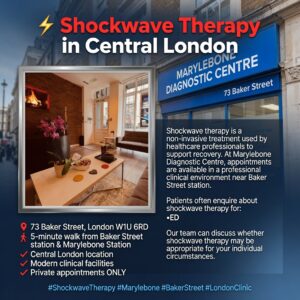
Marylebone Diagnostic Centre provides erectile dysfunction assessment and shockwave therapy from its Baker Street location in Central London.
The purpose of assessment is to establish whether shockwave therapy is a reasonable option for the individual patient and whether additional investigation or specialist management should be considered.
Men considering treatment should have realistic expectations. Some appropriately selected patients may experience improvement, but results vary and treatment cannot be guaranteed to restore normal erectile function.
The key point
Shockwave therapy is a promising non-invasive option for selected men with erectile dysfunction, particularly when vascular factors are involved.
Current evidence suggests a potential improvement in erectile function, but the effect is generally modest and the quality of evidence remains variable. Patient selection and appropriate clinical assessment are therefore important.
For men experiencing persistent ED, the first question should not simply be “Can I have shockwave therapy?” but “What is causing my erectile dysfunction, and is shockwave therapy appropriate for me?”
References
- EAU Guidelines on Sexual and Reproductive Health – Management of Erectile Dysfunction. European Association of Urology. 2026
Written by Mr Tharb Faisl
Writer / Scientist
Medically reviewed by Mr Giulio Garaffa
Consultant Urological Surgeon
Last medically reviewed: 4 September 2026