
Can You Have High Sperm DNA Fragmentation With a Normal Sperm Count?


- First: What Does a "Normal Sperm Count" Actually Mean?
- What Does Sperm DNA Fragmentation Measure?
- So Can My Sperm Count Be Normal but DNA Fragmentation High?
- Think of Sperm Quantity and Sperm DNA Quality Separately
- What If My Entire Semen Analysis Is Normal?
- Why Doesn't Semen Analysis Detect DNA Fragmentation?
- Does Normal Morphology Mean My Sperm DNA Is Healthy?
- Does Good Motility Mean Low DNA Fragmentation?
- Why Could DNA Fragmentation Be High If Everything Else Looks Normal?
- If My Sperm Count Is Normal, Should I Automatically Get a DNA Fragmentation Test?
- Normal Sperm Count but Not Getting Pregnant: What Else Should Be Considered?
- Can DNA Fragmentation Improve Even If My Sperm Count Is Already Normal?
- Male Fertility Testing at Marylebone Diagnostic Centre
- Frequently Asked Questions
You have had a sperm test.
Your sperm count is normal.
Perhaps your motility is good too. Your morphology may even be within the laboratory's expected range.
But you and your partner are still struggling to conceive.
This can lead to an important question: can sperm DNA fragmentation still be high even when sperm count is normal?
This does not mean that every man with a normal sperm count needs DNA fragmentation testing.
But it explains why a normal sperm count alone cannot provide a complete assessment of male fertility.
First: What Does a "Normal Sperm Count" Actually Mean?
When patients say "My sperm count was normal," they may actually be referring to several different things.
A comprehensive semen analysis doesn't just count sperm. It usually assesses semen volume, sperm concentration, total sperm number, progressive motility, total motility, morphology and other laboratory characteristics.
Sperm concentration tells us approximately how many sperm are present per millilitre of semen.
Total sperm number considers the total number of sperm within the entire ejaculate.
Both are important measurements.
But neither directly tells us whether the DNA carried inside those sperm is intact.
What Does Sperm DNA Fragmentation Measure?
A sperm cell has an important biological job.
It needs to reach and fertilise an egg, but it also carries approximately half of the nuclear genetic material required to create an embryo.
That DNA is tightly packaged inside the sperm head.
Sperm DNA fragmentation (SDF) refers to breaks or damage affecting that genetic material.
DNA fragmentation testing therefore asks a very different question from sperm count.
Sperm count asks, "How many sperm are there?" Motility asks, "How well are they moving?" Morphology asks, "What do they look like?" DNA fragmentation asks, "How intact is the DNA they are carrying?"
This distinction is the key to understanding this article.
So Can My Sperm Count Be Normal but DNA Fragmentation High?
Yes.
There is research showing that elevated sperm DNA fragmentation can occur in men whose conventional semen parameters are within recognised reference ranges.
Recent clinical guidance also discusses sperm DNA fragmentation as potentially useful in selected cases of unexplained infertility where routine semen parameters do not explain the fertility problem.
This means two statements can both be true: "You have a normal sperm count" and "Your sperm DNA fragmentation is elevated."
There is no contradiction. The tests are simply looking at different characteristics.
Think of Sperm Quantity and Sperm DNA Quality Separately
A simple analogy can help.
Imagine receiving 100 sealed envelopes.
Counting the envelopes tells you: quantity = 100.
But counting them doesn't tell you whether the documents contained inside are intact.
Sperm count works somewhat similarly.
It tells us something extremely important about quantity.
DNA fragmentation testing provides information about the genetic material carried by those sperm.
The analogy isn't biologically perfect, of course, but it illustrates why one measurement cannot substitute for the other.
What If My Entire Semen Analysis Is Normal?
This is an even more important question.
Perhaps it isn't only your sperm count that looks reassuring.
Your report might show reassuring concentration, motility, morphology and volume.
Can DNA fragmentation still be elevated?
Potentially, yes.
Research has found that sperm DNA integrity does not always correlate strongly with conventional semen characteristics. Some men with conventional parameters above reference thresholds can still demonstrate elevated DNA fragmentation.
This is one reason conventional semen analysis should be understood correctly.
A semen analysis is extremely valuable. But it is not a definitive fertility test.
It cannot tell us with certainty, "This man is fertile" or "This man is infertile."
Instead, it gives doctors important information about several measurable characteristics of semen and sperm.
Why Doesn't Semen Analysis Detect DNA Fragmentation?
Because conventional semen analysis was not designed to directly measure DNA strand damage.
Laboratory assessment of sperm concentration, movement and morphology involves different methodologies from those used to investigate sperm DNA integrity.
Specialised sperm DNA fragmentation assays include methods such as Sperm Chromatin Dispersion (SCD), Sperm Chromatin Structure Assay (SCSA), TUNEL and Comet assay.
These methods do not all measure DNA damage in exactly the same way.
That is also why patients should be cautious about comparing a percentage from one DNA-fragmentation method directly with a threshold found online for another assay. Reviews and guidelines note meaningful differences between testing methodologies and thresholds.
Does Normal Morphology Mean My Sperm DNA Is Healthy?
Not necessarily.
Morphology assesses the physical form of sperm according to laboratory criteria. DNA integrity is a different characteristic.
There can certainly be relationships between poorer conventional semen parameters and increased DNA fragmentation across populations. Research has reported associations involving morphology, motility and concentration.
But these relationships are not strong enough to say "normal morphology equals normal DNA" or "abnormal morphology equals damaged DNA."
That is too simplistic.
Does Good Motility Mean Low DNA Fragmentation?
Again, not necessarily.
Motility tells us whether sperm are moving and how effectively they are progressing.
That is important for fertility.
But a moving sperm cell can still carry DNA damage.
Therefore, good movement does not automatically guarantee intact DNA.
Why Could DNA Fragmentation Be High If Everything Else Looks Normal?
This is where the investigation becomes interesting.
Sperm DNA damage can arise through several biological mechanisms and can potentially be influenced by medical, environmental and lifestyle factors. These can include:
Oxidative Stress
Excessive oxidative stress can damage sperm membranes and genetic material.
Varicocele
A clinically significant varicocele may adversely affect testicular function and has been associated with elevated sperm DNA fragmentation.
Smoking
Smoking can increase oxidative stress and has been associated with poorer sperm health.
Recent Fever or Significant Illness
Sperm production can be temporarily affected following fever or systemic illness. This is particularly important because a man's semen or DNA fragmentation result today may partly reflect events that occurred weeks earlier.
Heat Exposure
Repeated significant testicular heat exposure may adversely affect sperm production and quality.
Increasing Paternal Age
Increasing age has been associated with greater sperm DNA fragmentation in some studies, although age alone does not determine an individual's fertility.
Infection or Inflammation
Certain reproductive-tract infections or inflammatory conditions may influence sperm health. However, high DNA fragmentation does not automatically mean infection, so microbiological testing should have a clinical reason.
Lifestyle, Metabolic and Environmental Factors
Obesity, metabolic health and certain occupational or environmental exposures have also been associated with elevated sperm DNA fragmentation. And sometimes there is no immediately obvious explanation.
If My Sperm Count Is Normal, Should I Automatically Get a DNA Fragmentation Test?
No. This is very important.
The fact that DNA fragmentation can be elevated with a normal sperm count does not mean that every man should automatically have the test.
If you are just beginning a fertility investigation, a comprehensive semen analysis remains an important first-line male assessment.
Additional testing should ideally answer a specific clinical question.
DNA fragmentation testing may become more relevant in selected situations such as unexplained infertility, persistent difficulty conceiving despite reassuring semen parameters, recurrent pregnancy loss, relevant male fertility risk factors, some unsuccessful assisted-reproduction histories, certain cases of varicocele, or situations where a fertility specialist believes the result may influence management.
Evidence and guidelines remain more cautious about using DNA fragmentation as a routine screening test for every infertile man.
The MDC principle should therefore be: don't order an advanced fertility test simply because it exists. Order it when the result could help answer an unresolved fertility question.
Normal Sperm Count but Not Getting Pregnant: What Else Should Be Considered?
This is probably the highest-value section of the entire article.
If you and your partner are not conceiving despite a normal sperm count, do not assume the man has been completely "cleared."
But equally, do not assume sperm DNA fragmentation must be the problem.
Fertility is a couple-level process.
The next investigation depends on what has already been assessed.
Look at the Full Semen Analysis
First, was only sperm concentration measured, or was a comprehensive semen analysis performed?
Look at concentration, total sperm number, progressive motility, total motility, morphology, volume and other reported findings.
A single normal number does not represent the entire semen analysis.
Consider Sperm DNA Integrity Where Appropriate
If conventional semen parameters are reassuring but infertility remains unexplained, DNA fragmentation may provide additional information in selected cases.
Consider Male Reproductive Hormones
Depending on the clinical history, testing may include FSH, LH, Testosterone, SHBG and Prolactin. Hormones provide information about another part of male reproductive physiology.
Consider Medical Assessment
Sometimes another blood test isn't the answer. An andrologist or urologist may need to assess for issues such as varicocele, testicular abnormalities, previous surgery, medication effects, sexual or ejaculatory problems, or relevant medical history.
Consider the Other Partner
This cannot be overstated. Pregnancy requires both partners.
Depending on the circumstances, female fertility investigation may involve ovulation assessment, reproductive hormones, ovarian reserve, ultrasound, tubal assessment, and medical and reproductive history.
The objective isn't to keep testing the man until something abnormal appears. It is to understand the couple's fertility picture.
What If My Count, Motility and Morphology Are All Normal?
This is sometimes described as normozoospermia, depending on the parameters and reference criteria used.
It is reassuring. But it does not equal "guaranteed fertility."
Research into unexplained infertility has demonstrated that a subset of men with normal conventional semen parameters can have elevated sperm DNA fragmentation.
This is why the statement "Your sperm test is normal, therefore there cannot be a male factor" is too absolute.
A better statement is: "Your conventional semen parameters are reassuring. Whether additional male investigation is worthwhile depends on your fertility history."
That is medically much more accurate.
Can High DNA Fragmentation Affect Natural Pregnancy?
Elevated sperm DNA fragmentation has been associated with poorer reproductive outcomes in several clinical settings, but it should not be interpreted as an absolute predictor of whether an individual couple will conceive.
A high result does not mean natural pregnancy is impossible. And a low result does not mean natural pregnancy is guaranteed.
This is a risk marker and an additional piece of diagnostic information, not a fertility crystal ball.
Can High DNA Fragmentation Affect Embryo Development?
Sperm DNA contributes genetic information to the embryo after fertilisation.
Research has therefore investigated relationships between increased sperm DNA damage and fertilisation, embryo development, implantation, pregnancy and pregnancy loss. Recent reviews continue to consider SDF biologically and clinically relevant, while also highlighting limitations in the evidence and differences between assays and patient populations.
Again, MDC should be careful not to turn an association into a guarantee of outcome.
Can High DNA Fragmentation Cause Miscarriage?
Elevated sperm DNA fragmentation has been associated with pregnancy loss and recurrent pregnancy loss.
But a high result cannot prove that sperm caused an individual miscarriage.
This deserves its own detailed discussion, which is why we have a separate guide: Can High Sperm DNA Fragmentation Cause Miscarriage?
Can DNA Fragmentation Improve Even If My Sperm Count Is Already Normal?
Potentially.
Count and DNA integrity are separate characteristics.
Therefore, someone could theoretically maintain a normal sperm concentration while DNA fragmentation changes over time.
Where a potentially modifiable factor is identified, addressing it may be appropriate.
Examples could include stopping smoking, recovering from significant febrile illness, addressing clinically significant varicocele, reducing relevant heat exposure, improving metabolic health, or addressing a medical or reproductive condition where identified.
But MDC should avoid promising, "Do X and your DNA fragmentation will become normal."
Individual response varies.
Should I Take Antioxidants?
Not automatically.
This is an area where commercial fertility marketing can become excessive.
Oxidative stress is an important mechanism associated with sperm DNA damage.
That does not mean that every man with high fragmentation requires the same supplement combination.
Before spending hundreds of pounds on fertility supplements, it is more sensible to ask, "Why might my DNA fragmentation be elevated?"
Treating or modifying an identifiable cause is very different from blindly taking supplements.
Should I Repeat the Test?
Possibly, if there is a reason.
Repeat DNA fragmentation testing may be considered after addressing a potentially relevant factor, recovering from illness, medical treatment, lifestyle modification, or specialist recommendation.
But ask, "Will the repeat result change what we do?"
If the answer is no, repeating the test may simply generate another number.
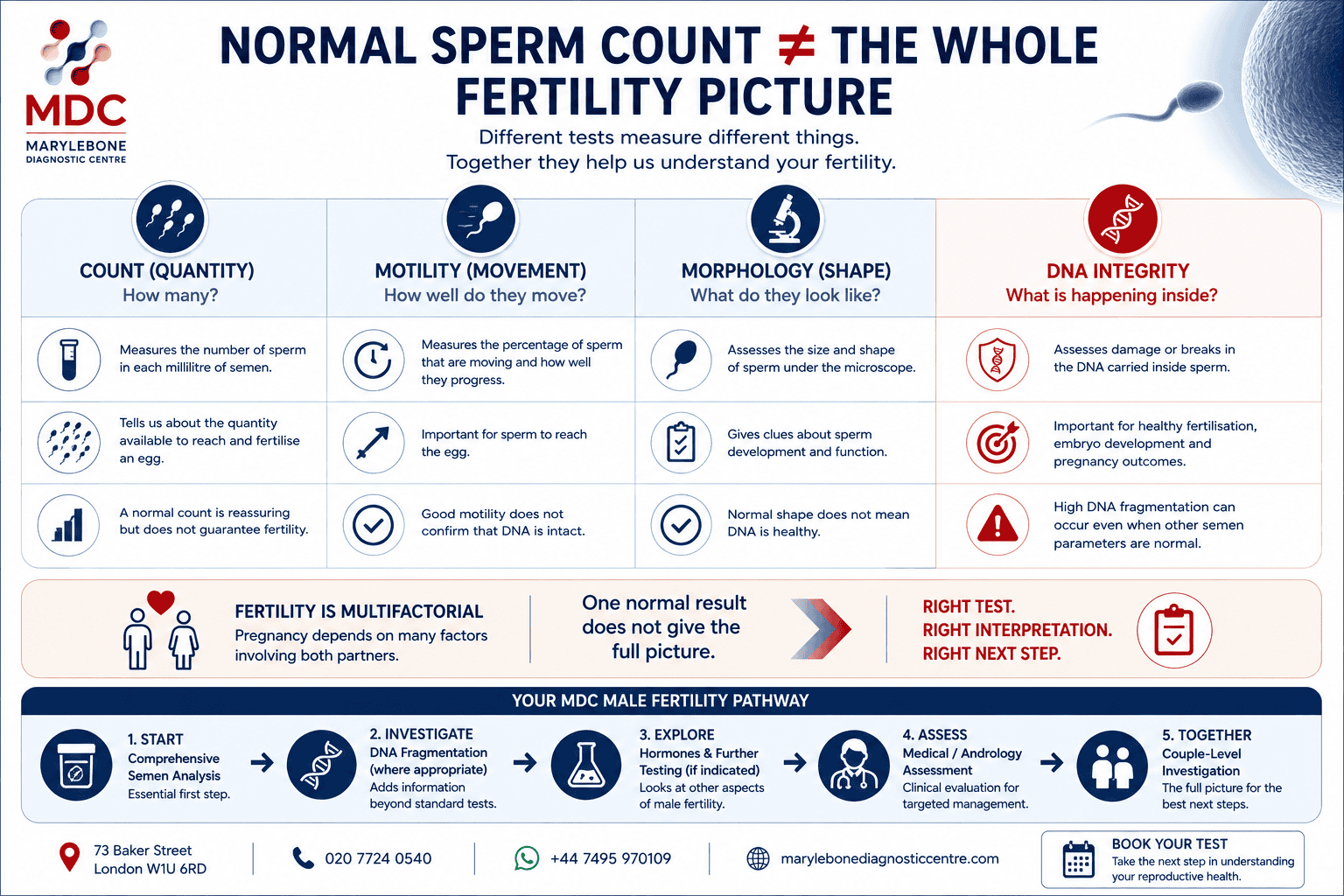
Male Fertility Testing at Marylebone Diagnostic Centre
Marylebone Diagnostic Centre provides male fertility diagnostics from 73 Baker Street, Central London.
The aim is not simply to offer more tests. It is to help patients move logically through their fertility investigation.
Comprehensive Semen Analysis
For men who have not yet had a proper fertility assessment, this is generally an important starting point. It examines concentration, total sperm number, motility, morphology and other semen characteristics.
Sperm DNA Fragmentation
For selected patients, DNA fragmentation testing can provide additional information about sperm DNA integrity that conventional semen analysis does not directly measure.
Male Fertility Hormone Testing
Hormonal assessment can help investigate endocrine aspects of male reproductive function where appropriate.
Andrology / Urology
Where results or medical history indicate that a clinical assessment is needed, patients can move beyond laboratory testing into appropriate specialist investigation.
The objective is: semen, then DNA where appropriate, then hormones/clinical investigation where indicated, rather than testing everything and hoping something explains the problem.
73 Baker Street
London W1U 6RD
Central London, near Baker Street Station
Frequently Asked Questions
Can you have high DNA fragmentation with a normal sperm count?
Yes. Sperm concentration measures the number of sperm present, while DNA fragmentation testing assesses damage to the genetic material carried inside sperm. A normal count therefore does not guarantee low DNA fragmentation.
Can DNA fragmentation be high with a normal semen analysis?
Yes. Research has identified elevated sperm DNA fragmentation in a subset of infertile men with otherwise normal conventional semen parameters.
Does a normal sperm count mean I am fertile?
No. A normal sperm count is reassuring but cannot prove fertility. Fertility depends on numerous male, female and couple-related factors.
Does good sperm motility mean the DNA is healthy?
Not necessarily. Motility measures sperm movement; it does not directly assess DNA integrity.
Does normal sperm morphology mean normal DNA fragmentation?
No. Morphology assesses sperm appearance. DNA fragmentation assesses genetic material inside sperm.
Can I have good sperm but still be infertile?
A man can have conventional semen parameters within recognised reference ranges and still experience infertility as part of a couple. This is one reason infertility sometimes remains unexplained after first-line testing.
Why are we not getting pregnant if my sperm count is normal?
There are many possible explanations. Other male factors, female reproductive factors, timing, age and unexplained infertility can all contribute. A normal sperm count should be interpreted as one part of a broader fertility assessment.
Should I get DNA fragmentation testing if my sperm count is normal?
Not automatically. It may provide useful additional information in selected cases such as unexplained infertility, recurrent pregnancy loss or certain unsuccessful fertility-treatment histories.
Is DNA fragmentation more important than sperm count?
They measure different things and should not be treated as competing tests. Conventional semen analysis remains fundamental, while DNA fragmentation may add information in selected circumstances.
Can high DNA fragmentation be treated?
The appropriate response depends on the cause. Potentially relevant factors can include varicocele, smoking, illness, heat exposure, metabolic health and other medical or environmental factors.
Can DNA fragmentation change while sperm count stays normal?
Yes. These measurements describe different characteristics of sperm and can potentially change independently.
What test should I have first?
For many men beginning a fertility investigation, comprehensive semen analysis is the logical first test. Whether DNA fragmentation, hormones or specialist assessment should follow depends on the result and the couple's fertility history.
The Bottom Line
Normal sperm count is good news. But it doesn't tell us everything about sperm.
A sperm concentration result answers "How many sperm are present?" It does not directly answer "How intact is their DNA?"
And even a comprehensive semen analysis, while extremely important, cannot assess every aspect of sperm function or guarantee fertility.
That is why some men with reassuring semen parameters can still have elevated sperm DNA fragmentation.
But the answer is not to DNA-test every man.
The answer is better diagnostics: start with the appropriate first-line investigation, understand what it tells you, identify what remains unanswered, then investigate further when there is a clinical reason.
At Marylebone Diagnostic Centre, that is how we want male fertility testing to work: not more testing for the sake of testing, but better information for the next decision.
Male Fertility Testing in Central London
Related reading: My Semen Analysis Is Normal, Could I Still Have a Fertility Problem?, Should I Get a Sperm DNA Fragmentation Test?, What Does a High Sperm DNA Fragmentation Result Actually Mean?

