
Can High Sperm DNA Fragmentation Cause Miscarriage? Understanding the Male Factor in Pregnancy Loss

- First: What Is Sperm DNA Fragmentation?
- How Could Sperm DNA Affect a Pregnancy?
- What Does the Research Say?
- What Do Fertility Guidelines Say?
- Does High DNA Fragmentation Mean the Man Caused the Miscarriage?
- Can You Have High DNA Fragmentation With a Normal Semen Analysis?
- Should the Male Partner Be Tested After a Miscarriage?
- What Male Fertility Tests Might Be Considered After Recurrent Miscarriage?
- What About the Female Partner?
- What Can Cause High Sperm DNA Fragmentation?
- If My DNA Fragmentation Is High, Can I Reduce My Miscarriage Risk?
- Male Fertility and DNA Fragmentation Testing in London
- Frequently Asked Questions
When a pregnancy ends in miscarriage, attention has traditionally focused heavily on the female partner.
But creating an embryo requires genetic material from both the egg and the sperm.
This raises an important question: can damage to sperm DNA contribute to miscarriage?
Research has found an association between higher sperm DNA fragmentation and recurrent pregnancy loss. However, this does not mean that a high DNA fragmentation result proves that the sperm caused a particular miscarriage.
Miscarriage is complex.
Chromosomal abnormalities, maternal age, uterine factors, hormonal conditions, genetic factors, medical conditions and other reproductive factors may all contribute. In many cases, no single explanation is identified.
The most useful way to think about sperm DNA fragmentation is therefore: high sperm DNA fragmentation may be one male-factor contributor to pregnancy loss in some couples, but it cannot establish the cause of an individual miscarriage.
For couples experiencing repeated pregnancy loss, the appropriate approach is not to blame either partner.
It is to investigate both partners as part of the same reproductive picture.
First: What Is Sperm DNA Fragmentation?
Every sperm carries genetic material.
If fertilisation occurs, the sperm contributes approximately half of the nuclear genetic material required to form an embryo.
That DNA is tightly packaged within the sperm head.
Sperm DNA fragmentation (SDF) refers to breaks or damage within this genetic material.
Some degree of DNA damage can occur naturally. The concern is whether the level of fragmentation is elevated according to the particular laboratory method used.
A sperm DNA fragmentation test therefore asks a different question from conventional semen analysis.
Semen analysis looks at sperm concentration, total sperm number, progressive motility, total motility, morphology, semen volume and other laboratory characteristics.
DNA fragmentation testing looks at the integrity of the DNA carried inside sperm.
This distinction becomes particularly important when a man's semen analysis appears reassuring but fertility problems continue.
How Could Sperm DNA Affect a Pregnancy?
Fertilisation is only the beginning of pregnancy.
The fertilised egg must undergo repeated cell division and develop into an embryo capable of implantation and continued development.
The sperm contributes genetic information to that process.
It is therefore biologically plausible that significant sperm DNA damage could influence reproductive outcomes.
However, biology is rarely as simple as damaged sperm DNA automatically equalling pregnancy loss.
The egg has some ability to repair sperm DNA damage after fertilisation, and reproductive outcomes depend on many interacting factors.
These can include the degree of sperm DNA damage, egg quality, maternal age, embryo genetics and the reproductive health of both partners.
This is one reason the same DNA fragmentation result may not have identical implications for every couple.
What Does the Research Say About Sperm DNA Fragmentation and Miscarriage?
There is evidence of an association.
A 2024 umbrella review examining meta-analyses of semen parameters and recurrent pregnancy loss found highly suggestive evidence for an association between sperm DNA fragmentation and recurrent pregnancy loss. The authors also cautioned that the methodological quality of the included meta-analyses was low or very low.
That nuance matters.
Research supports taking the male contribution seriously.
It does not justify telling a couple, "High DNA fragmentation caused your miscarriage."
Those are two very different statements.
What Do Fertility Guidelines Say?
This is particularly interesting because international guidance is not completely uniform.
The American AUA/ASRM male-infertility guideline recommends evaluating the male partner in couples with recurrent pregnancy losses, defined in that guideline as two or more, and states that clinicians should consider sperm DNA fragmentation testing in this clinical setting.
UK RCOG patient guidance also acknowledges that abnormal sperm DNA may be associated with a greater possibility of recurrent miscarriage. However, RCOG states that sperm testing is not usually offered because there is not currently good evidence that changing sperm health reduces miscarriage risk.
That is precisely why DNA fragmentation testing should be presented as an additional investigation in selected circumstances, rather than a universal miscarriage test.
Does High DNA Fragmentation Mean the Man Caused the Miscarriage?
No.
This needs to be said very clearly.
A laboratory result cannot assign responsibility for pregnancy loss.
Even when sperm DNA fragmentation is elevated, we cannot look backwards and determine that a particular sperm caused a particular miscarriage.
Miscarriage is often multifactorial.
In fact, RCOG notes that around half of miscarriages occur because the pregnancy developed with abnormal chromosomes, with the risk increasing as parents age.
So the appropriate question is not "Whose fault was the miscarriage?"
It is, "Are there identifiable factors in either partner that could be relevant to future pregnancies?"
That is a much more medically useful question.
Can You Have High DNA Fragmentation With a Normal Semen Analysis?
Yes. This is one of the most important reasons sperm DNA fragmentation enters the miscarriage discussion.
A man's semen analysis may show normal sperm concentration, good motility and acceptable morphology, and yet this does not directly establish that sperm DNA integrity is normal.
The AUA/ASRM guideline specifically notes that even with a normal semen analysis, sperm that appears morphologically and functionally normal may still have chromosomal abnormalities or high DNA fragmentation in certain clinical settings.
This is why couples can sometimes hear "His sperm test was normal" when what was actually tested was conventional semen quality.
That is valuable information, but it isn't every possible dimension of sperm health.
Does a Normal Sperm Count Rule Out Male Factors in Miscarriage?
No.
Sperm count tells us about quantity. It does not directly measure DNA fragmentation, chromosomal abnormalities, every aspect of sperm function or every possible male reproductive factor.
Likewise, an abnormal sperm count does not prove that sperm caused a miscarriage.
The male reproductive assessment has to be interpreted as a whole.
Should the Male Partner Be Tested After a Miscarriage?
Not necessarily after every single miscarriage.
Miscarriage is unfortunately common, and one pregnancy loss does not automatically mean that either partner has an underlying fertility disorder.
However, recurrent pregnancy loss changes the clinical question.
RCOG currently defines recurrent miscarriage as three or more first-trimester miscarriages, although it encourages clinicians to consider evaluation after two where there is suspicion that the losses may be pathological rather than sporadic.
The AUA/ASRM male-infertility guideline recommends male evaluation following two or more recurrent pregnancy losses.
Therefore, couples experiencing repeated losses should discuss an appropriate couple-level assessment with their healthcare team.
What Male Fertility Tests Might Be Considered After Recurrent Miscarriage?
There isn't one universal panel that every man requires.
Depending on history and previous investigations, assessment may include:
1. Comprehensive Semen Analysis
This remains a fundamental male fertility investigation. It examines sperm concentration, total sperm number, motility, morphology and other semen characteristics. Learn more about Comprehensive Semen Analysis at MDC.
2. Sperm DNA Fragmentation
This can provide additional information about sperm DNA integrity that a conventional semen analysis does not directly assess. It may be particularly relevant when conventional semen parameters appear reassuring but recurrent pregnancy loss remains unexplained. Learn more about the DNA Fragmentation Test at MDC.
3. Male Reproductive Hormones
Depending on the man's history and semen results, investigation may include hormones such as FSH, LH, Testosterone, SHBG and Prolactin.
Hormone testing does not diagnose the cause of miscarriage, but it may help identify other aspects of male reproductive dysfunction.
4. Medical / Andrology Assessment
Sometimes the most valuable next step is not another laboratory test.
Medical evaluation may identify factors such as varicocele, testicular abnormalities, medication effects, previous reproductive problems, relevant medical conditions or lifestyle/occupational exposures.
5. Genetic Investigation
In selected couples experiencing recurrent pregnancy loss, genetic assessment may be appropriate.
RCOG notes that both partners may be offered genetic testing in certain recurrent-miscarriage situations, particularly depending on pregnancy-tissue results or when pregnancy tissue could not be tested.
What About the Female Partner?
This is essential.
Testing sperm DNA should never replace appropriate investigation of the female partner.
Depending on the circumstances, recurrent-miscarriage investigation may involve assessment of antiphospholipid syndrome, thyroid function and thyroid antibodies, diabetes where clinically indicated, other hormonal abnormalities, genetic factors, uterine anatomy and other relevant reproductive factors.
RCOG recommends a structured investigation rather than assuming one explanation for recurrent miscarriage.
The most useful model is therefore: male assessment plus female assessment plus pregnancy history equals couple-level investigation, rather than investigating each partner in isolation.
What Can Cause High Sperm DNA Fragmentation?
Potential contributors can include oxidative stress, smoking, varicocele, increasing paternal age, recent fever or significant illness, significant heat exposure, some infections or inflammatory conditions, metabolic and lifestyle factors, and environmental or occupational exposures.
Sometimes no obvious explanation is identified.
This is why an elevated DNA fragmentation result should trigger interpretation, rather than an automatic treatment.
If My DNA Fragmentation Is High, Can I Reduce My Miscarriage Risk?
This is where we have to be particularly careful.
We have evidence showing an association between elevated sperm DNA fragmentation and recurrent pregnancy loss.
That is not the same as proving that lowering DNA fragmentation will necessarily prevent miscarriage.
RCOG explicitly highlights this evidence gap: although abnormal sperm DNA may be associated with recurrent miscarriage, there is currently insufficient evidence that changing sperm health reduces miscarriage risk.
Therefore MDC should not promise "Lower your DFI and prevent miscarriage."
Instead, if fragmentation is elevated, the sensible approach is to investigate potentially relevant and modifiable factors.
What Should a Man Do If DNA Fragmentation Is High?
Start by asking why it might be high.
A doctor may consider recent illness or fever, smoking, varicocele, significant heat exposure, relevant infection or inflammation, metabolic health, medication or medical history, and abnormal conventional semen parameters.
The appropriate intervention depends on what is identified.
Simply giving every patient the same supplements is not personalised male fertility medicine.
Do Antioxidants Prevent Miscarriage When DNA Fragmentation Is High?
There is not sufficient evidence to promise this.
Oxidative stress is an important mechanism in sperm DNA damage, which explains why antioxidants are frequently discussed in male fertility.
But the leap from "oxidative stress can damage sperm" to "antioxidant supplements will prevent miscarriage" is too large.
Patients should therefore be cautious about online supplement packages promising to "repair sperm DNA" or prevent pregnancy loss.
Where treatment is appropriate, it should be directed towards identifiable clinical factors.
Can Sperm DNA Fragmentation Improve?
Potentially, depending on the cause.
Sperm production is continuous. Therefore, sperm quality can change over time.
Potentially modifiable factors may include smoking, relevant heat exposure, metabolic health, recent illness, some environmental exposures and certain clinically identifiable male reproductive conditions.
However, improvement in a laboratory number does not automatically translate into a guaranteed pregnancy outcome.
How Long Before Sperm DNA Changes?
Sperm production and maturation occur over several weeks.
For that reason, changes in male reproductive health generally should not be assessed only a few days after an intervention.
Where repeat testing is clinically useful, reassessment may be considered after an appropriate interval based on the reason for testing and the intervention undertaken.
Should We Repeat DNA Fragmentation Before Trying Again?
Not automatically.
A repeat test may make sense if an identifiable factor has been addressed, the man has recovered from significant illness, treatment has been undertaken, the result would influence fertility-management decisions, or a doctor or fertility specialist recommends reassessment.
The best question is, "Would a different result change what we do next?"
If not, repeating the test may simply produce another number.
What If DNA Fragmentation Is Normal?
That is useful information too.
A reassuring DNA fragmentation result may make significant sperm DNA damage less likely according to the assay used.
But it cannot rule out every male reproductive factor.
And it certainly cannot identify the cause of recurrent miscarriage on its own.
The couple's broader investigation remains important.
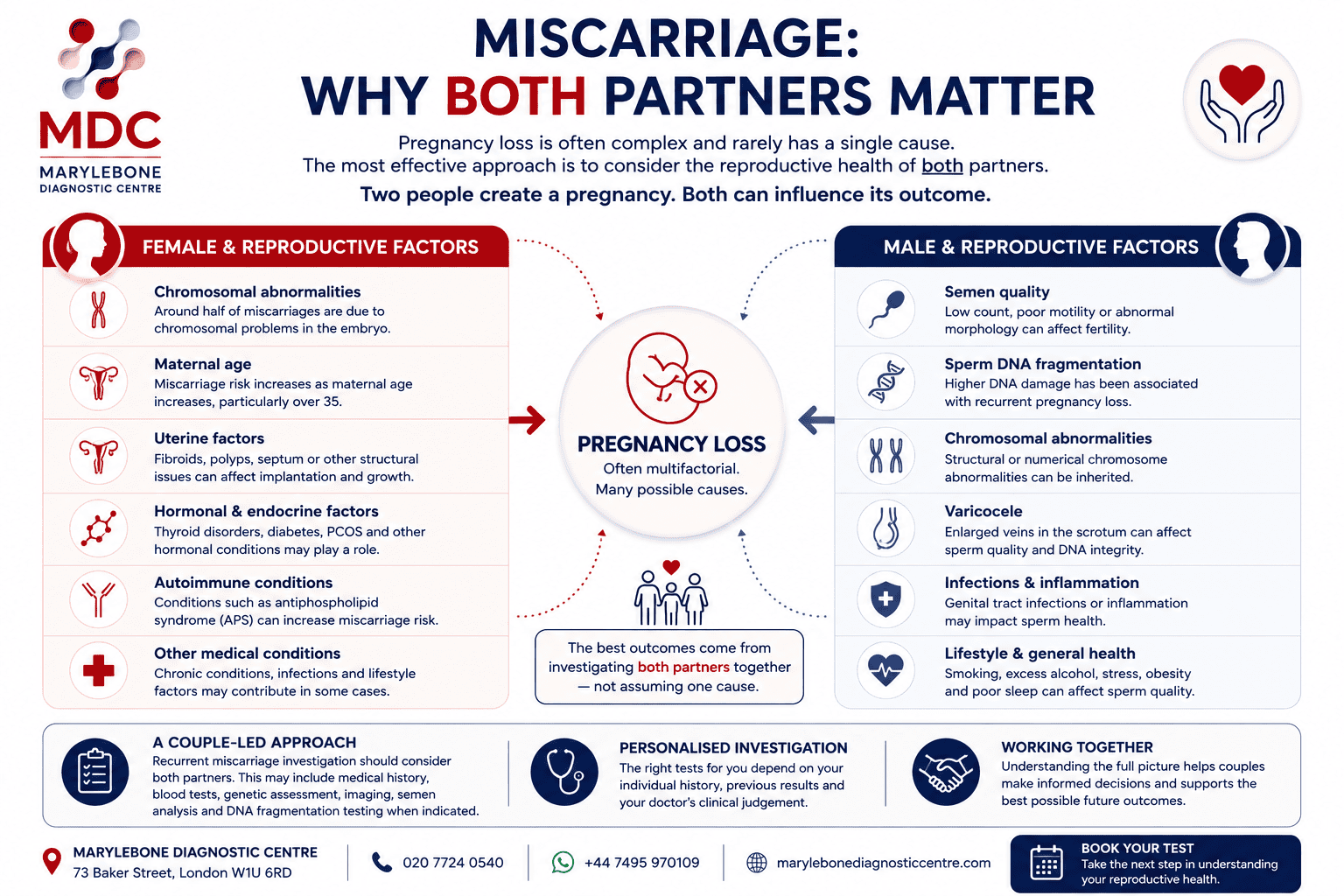
Recurrent Pregnancy Loss: Think About the Couple, Not Just One Partner
Perhaps the most important message from this entire article is this: pregnancy is created by two people.
And recurrent pregnancy loss deserves a couple-level investigation.
For many years, the male contribution received comparatively little attention once fertilisation had occurred.
The growing body of research around sperm DNA fragmentation has helped challenge that assumption.
But we should not swing too far in the opposite direction.
The correct message is not "Miscarriage is caused by sperm DNA."
It is, "Male reproductive health may be relevant to pregnancy loss and deserves consideration alongside female and pregnancy-related factors."
That is a much more scientifically responsible position.
Male Fertility and DNA Fragmentation Testing in London
Marylebone Diagnostic Centre provides male fertility diagnostics from 73 Baker Street, Central London.
Testing available through MDC includes:
- Comprehensive Semen Analysis, assessment of conventional sperm parameters including concentration, motility and morphology
- Sperm DNA Fragmentation Testing, assessment of sperm DNA integrity beyond conventional semen analysis
- Male Reproductive Hormone Testing, hormonal investigation where appropriate
- Comprehensive Male Fertility Assessment, for men requiring a broader investigation rather than a single test
- Andrology / Urology Assessment, where clinical evaluation is more appropriate than simply ordering additional laboratory tests
MDC's approach should remain simple: right test, right interpretation, right next step.
73 Baker Street
London W1U 6RD
Central London, near Baker Street Station
Frequently Asked Questions
Can sperm DNA fragmentation cause miscarriage?
Elevated sperm DNA fragmentation has been associated with recurrent pregnancy loss in research. However, a high result cannot prove that sperm DNA damage caused an individual miscarriage.
Can bad sperm cause miscarriage?
Male reproductive factors can contribute to reproductive outcomes, but "bad sperm" is not a medically useful description. Pregnancy loss has many possible causes, and assessment should consider both partners.
Can you miscarry because of sperm quality?
Potentially, male factors may contribute to pregnancy-loss risk in some couples. However, an individual miscarriage cannot usually be attributed to sperm quality alone.
Can high DNA fragmentation cause recurrent miscarriage?
Research supports an association between elevated sperm DNA fragmentation and recurrent pregnancy loss. The strength and clinical implications of this association continue to be studied.
Should the man be tested after recurrent miscarriage?
Male evaluation should be considered as part of a couple-level assessment. AUA/ASRM recommends evaluating the male partner after two or more recurrent pregnancy losses. UK pathways can differ, with RCOG defining recurrent miscarriage as three or more early miscarriages while allowing earlier investigation based on clinical judgement.
Should I get DNA fragmentation testing after one miscarriage?
Not routinely simply because one miscarriage has occurred. Whether testing is appropriate depends on the couple's fertility history, age, semen results, other risk factors and medical advice.
Can high DNA fragmentation occur with normal sperm count?
Yes. Sperm concentration and sperm DNA integrity measure different characteristics.
Can high DNA fragmentation occur with normal morphology?
Yes. Morphology evaluates sperm appearance; it does not directly assess DNA integrity.
Does high DNA fragmentation mean we need IVF?
No. A DNA fragmentation result alone should not determine fertility treatment.
Does ICSI prevent miscarriage from sperm DNA fragmentation?
ICSI does not repair sperm DNA. Treatment decisions need to consider the couple's overall fertility situation.
Can DNA fragmentation improve?
Potentially, depending on the cause. However, improvement in DFI cannot be promised to prevent future miscarriage.
Can antioxidants reduce miscarriage risk?
There is insufficient evidence to promise that antioxidant supplementation will prevent miscarriage by reducing sperm DNA fragmentation.
What should we test after recurrent miscarriage?
There is no single universal panel. Appropriate investigation can involve both partners and may include reproductive history, blood tests, uterine assessment, genetic investigation and selected male fertility investigations. RCOG recommends structured recurrent-miscarriage assessment.
The Bottom Line
Can high sperm DNA fragmentation contribute to miscarriage?
Research suggests that elevated sperm DNA fragmentation is associated with recurrent pregnancy loss.
But association is not proof of causation.
A high result does not tell us "The sperm caused the miscarriage."
Nor does a normal result tell us "The man cannot be involved."
The better approach is to recognise that pregnancy depends on the reproductive health of both partners.
When pregnancy losses recur, male reproductive health deserves consideration alongside maternal, genetic, hormonal, anatomical and pregnancy-related factors.
At Marylebone Diagnostic Centre, our philosophy is therefore not to look for someone to blame.
It is to ask a better question: "What information can help this couple understand their reproductive health and make the most appropriate next decision?"
That is what good diagnostics should do.
Continue Your Male Fertility Investigation
Related reading: My Semen Analysis Is Normal, Could I Still Have a Fertility Problem?, Should I Get a Sperm DNA Fragmentation Test?, What Does a High Sperm DNA Fragmentation Result Actually Mean?.

