
What Your Semen Colour Is Telling You — And When to Actually Do Something About It

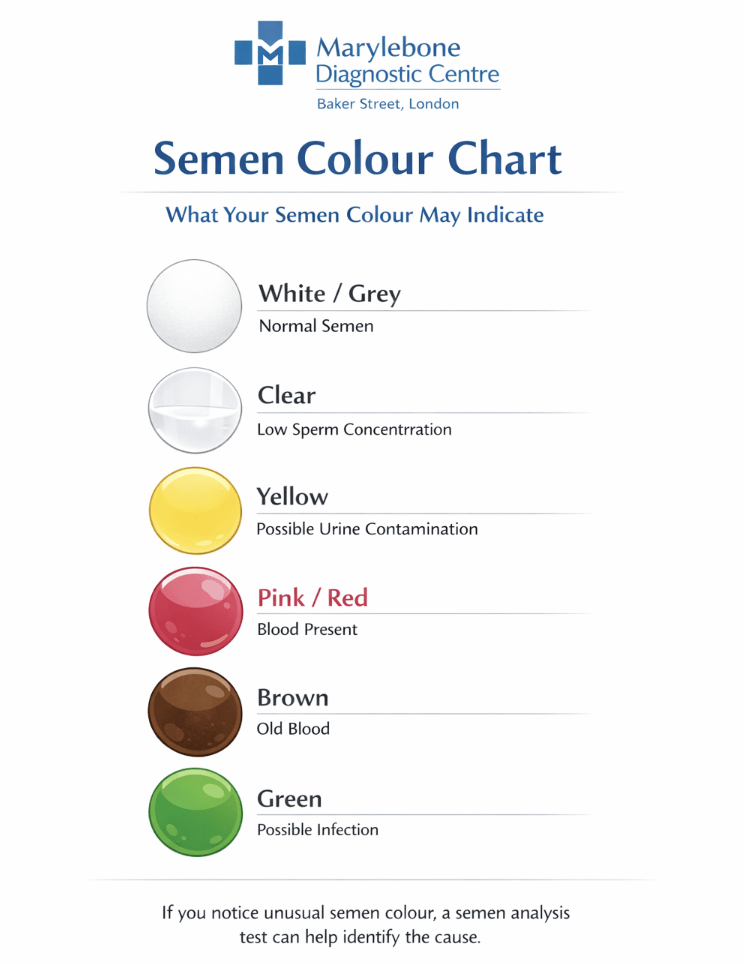
Most men who notice a change in semen colour do one of two things: they either panic unnecessarily, or they ignore something that deserves attention. The problem is that semen colour alone is not a reliable indicator of reproductive health — context is everything.
This guide is not a colour chart. It is a decision-making framework. It helps you understand what a colour change might mean given your full picture — your symptoms, your timeline, your fertility goals — and whether that picture warrants a clinical assessment or not.
Because the real question is never just "what colour is it?" It is: "Given what I'm seeing, what should I actually do?"
It Happened Once vs. It Keeps Happening
The single most important factor when evaluating a semen colour change is whether it is a one-off event or a recurring pattern. A single unusual episode is almost always benign. Repeated or persistent changes are a different matter.
The body changes. Ejaculation frequency, diet, hydration, supplements, stress levels, and recent illness all affect semen appearance from one day to the next. A yellow tinge after a long period of abstinence, or watery semen after several ejaculations in quick succession — these are physiological responses, not symptoms.
What changes the calculus is persistence. If a colour abnormality is present across multiple ejaculations over days or weeks, particularly when accompanied by any other symptom — pain, burning, odour, urinary changes — that pattern warrants investigation. The colour itself is not the diagnosis. The pattern is.
What Each Colour May Indicate
The semen colour chart provides a visual reference for common variations. Below is a more clinically contextualised breakdown — not just what each colour can mean, but what it likely means given different circumstances.
| Colour | Common causes | When to consider testing | Urgency |
|---|---|---|---|
| White / Grey | Normal healthy semen. Whitish-grey is the standard appearance. | No concern if other parameters are normal. | None |
| Clear / Watery | Frequent ejaculation, high hydration, or temporarily reduced sperm concentration. | If persistent and fertility is a concern — watery semen may indicate low sperm concentration. | Monitor |
| Yellow | Abstinence, diet (turmeric, asparagus), vitamins, mild infection, urine mixing. | If accompanied by pain, burning, strong odour, or lasting more than a week. | Monitor |
| Green | Bacterial infection — prostatitis or sexually transmitted infection most likely. | Always. Green semen is the clearest colour-based signal of active infection. | Act |
| Pink / Red | Blood in semen (haematospermia) — prostate inflammation, infection, minor injury, recent procedure. | If it happens more than once. A single episode in a healthy man under 40 is often self-limiting. | Act if recurring |
| Brown | Older blood — prior minor bleeding or inflammation that has partially resolved. | If repeated or accompanied by pain, urinary symptoms, or fertility concerns. | Monitor |
Lifestyle Factors That Change Semen Colour
Many semen colour changes are driven entirely by modifiable lifestyle factors. Understanding these makes it significantly easier to distinguish a physiological variation from a clinical signal.
Diet and Supplements
Certain foods and supplements are well-documented causes of yellow or altered semen. Turmeric, asparagus, and B vitamins are among the most common culprits. High doses of riboflavin (B2) in particular can produce a noticeably yellow tinge. If a colour change coincides with starting a new supplement, that is the most likely explanation.
Hydration
Dehydration concentrates seminal fluid, which can deepen colour and alter consistency. Conversely, very high hydration can produce clear or watery semen. Neither extreme is diagnostic on its own — both typically resolve with normal hydration patterns.
Ejaculation Frequency
Long periods of abstinence often produce more yellowish semen, due to the natural degradation of seminal fluid proteins over time. Frequent ejaculation can produce clearer, more watery semen with lower sperm concentration. Both are normal physiological responses — not indicators of pathology.
Medications
Some antibiotics, antifungals, and anti-inflammatories may temporarily affect semen colour or consistency. If a change began shortly after starting a new medication, note it and consider mentioning it at your next appointment — but do not stop medication without clinical advice.
Recent Illness or Fever
High fevers — even those that have resolved — can temporarily disrupt sperm production and alter semen appearance. The effect may persist for up to 90 days after illness, because sperm takes approximately three months to mature. A single colour change following recent illness is almost always transient.
When Colour Is Misleading
This is the section most guides omit. Semen colour is a useful but imperfect signal — and in some of the most clinically significant fertility situations, it tells you almost nothing.
A man with entirely normal-looking, healthy-white semen can have:
- A very low sperm count (oligospermia) or no sperm at all (azoospermia)
- High levels of sperm DNA fragmentation that impair embryo development
- Poor sperm motility that prevents natural fertilisation
- Antisperm antibodies that compromise fertilisation even when sperm count is normal
None of these conditions change semen colour. They are invisible to the naked eye. The only way to identify them is through a clinical semen analysis and, where indicated, advanced testing.
This is why colour is a starting point for concern — not a measure of fertility. A man who is trying to conceive should not be reassured by normal-looking semen, and should not be alarmed purely because of a single colour variation.
Decision Guide: What to Do Based on What You're Seeing
Rather than a simple colour lookup, use this framework. Match your situation to the scenario that most closely fits.
Beyond Semen Colour: Advanced Testing You May Need
A standard semen analysis is the first-line investigation for male reproductive health. But depending on results, further testing may reveal issues that standard parameters miss.
Semen Analysis
A private semen analysis in London evaluates sperm count, motility (movement), morphology (shape), volume, pH, and vitality. These parameters provide the clinical baseline for any fertility assessment. Results are available within 24–42 hours at Marylebone Diagnostic Centre.
A result within normal WHO reference ranges does not fully exclude male factor infertility — it simply means the standard parameters are acceptable. Further investigation may still be warranted depending on clinical context.
Sperm DNA Fragmentation Testing
This is the test that standard semen analysis does not include — and one of the most clinically significant for couples experiencing unexplained infertility or recurrent miscarriage.
Sperm DNA fragmentation measures the degree of damage within the genetic material carried by sperm cells. High fragmentation levels can impair fertilisation, reduce embryo quality, and increase miscarriage risk — even when sperm count, motility, and morphology appear normal.
A UK study of 203 IVF couples found that live birth rates dropped from approximately 33% when sperm DNA damage was below 25%, to just 13% when damage exceeded 50%. The semen of both groups looked entirely normal on standard analysis.
Sperm Antibody Testing
In some cases, the immune system produces antibodies that attach to sperm and impair their ability to move or fertilise. The MAR (Mixed Antiglobulin Reaction) test and ASA (Antisperm Antibody) test identify this. It is an often-overlooked cause of subfertility in men whose standard parameters are otherwise unremarkable.
Male Hormone Profile
Hormonal imbalances affecting testosterone, FSH, LH, and prolactin can suppress sperm production and affect semen quality. A male hormone blood test can identify endocrine causes of male infertility that semen analysis alone will not detect.
Key Takeaways
Frequently Asked Questions
Phone: 020 7724 0540 · WhatsApp: 07495 970109 · Hours: Mon–Sat, 8:00am – 4:00pm
Not sure whether to act on what you're seeing?
A private semen analysis at Marylebone Diagnostic Centre gives you clinical clarity — not guesswork. Results within 24–42 hours, no GP referral required, with a full laboratory report covering all key fertility parameters.

