Normal sperm results. Still waiting for pregnancy?
Receiving a normal semen analysis result can be reassuring. However, when pregnancy still does not occur, many couples are left wondering whether something important has been missed.
Fertility depends on more than sperm count, movement and appearance. Understanding the reproductive health of both partners is essential when deciding what to investigate next.
Quick answer
Yes, difficulty conceiving is possible even when a semen analysis is normal. Standard semen analysis evaluates measurable characteristics of semen and sperm, but it cannot establish whether a couple will achieve pregnancy.
The next step is usually a fertility assessment involving both partners. Depending on their medical history, this may include reviewing the semen report, assessing ovulation, evaluating the fallopian tubes and reproductive anatomy, and investigating relevant hormonal or male reproductive health concerns.
Additional tests should be selected according to clinical findings rather than ordered automatically. If the initial investigations do not reveal a cause, a specialist may diagnose unexplained infertility.
In London, Marylebone Diagnostic Centre provides private semen analysis, fertility blood testing and couples’ fertility assessment from its clinic at 73 Baker Street, Marylebone, London W1U 6RD.
Learn about fertility investigations for both partners1. What does a normal semen analysis actually mean?
A semen analysis is one of the principal laboratory investigations used when assessing male fertility. It examines several characteristics of the semen sample, including sperm concentration, total sperm number, motility and morphology.
The World Health Organization (WHO) publishes reference values derived from semen samples from men whose partners conceived naturally within a defined period.
These values provide a useful clinical reference. They are not strict boundaries separating fertile men from infertile men.
| Parameter | Reference value | What it measures |
|---|---|---|
| Semen volume | 1.4 mL or more | Amount of semen ejaculated |
| Sperm concentration | 16 million/mL or more | Sperm number per millilitre |
| Total sperm number | 39 million or more | Total sperm in the ejaculate |
| Total motility | 42% or more | Proportion of moving sperm |
| Progressive motility | 30% or more | Sperm moving progressively |
| Morphology | 4% or more | Proportion meeting normal shape criteria |
| Vitality | 54% or more | Proportion of living sperm, when assessed |
Reference: WHO Laboratory Manual, sixth edition, 2021; NICE NG257, 2026. Individual results should be interpreted alongside medical history and laboratory methodology.
A normal sperm count does not necessarily mean that every aspect of male fertility has been assessed. Equally, a result below a reference limit does not necessarily mean that natural conception is impossible.
Marylebone Diagnostic Centre performs semen analysis using assessment criteria based on the WHO sixth-edition laboratory manual.
If you have not yet had a comprehensive assessment, you can read more about the semen analysis test at MDC in London .
2. Why can pregnancy fail to occur despite normal sperm results?
Conception involves several biological processes. Ovulation must occur, sperm must reach the egg, fertilisation must take place, and the resulting embryo must develop and implant successfully.
A conventional semen analysis cannot evaluate every stage of this process.
Ovulation and hormonal factors
Ovulation disorders, thyroid dysfunction and conditions such as polycystic ovary syndrome may interfere with conception. Regular periods can be reassuring but do not exclude every reproductive problem.
Fallopian tube problems
Previous pelvic infections, surgery or endometriosis may affect the fallopian tubes. These problems cannot be diagnosed through semen analysis or fertility blood testing alone.
Age-related fertility changes
Female age is an important factor in reproductive potential. Male age and general reproductive health may also influence fertility outcomes.
Male reproductive health
Sexual dysfunction, medication use, previous testicular disease, varicocele and other reproductive conditions may require clinical assessment even when laboratory results appear reassuring.
Timing and sexual health
Infrequent intercourse, difficulties with ejaculation or erections, and uncertainty about the fertile window can affect the opportunity for conception.
Unexplained infertility
Sometimes standard investigations do not identify an explanation. This does not mean that either partner is to blame or that further treatment options are unavailable.
3. What should we investigate next?
The appropriate next step depends on your age, reproductive history, previous results, medical conditions and the length of time you have been trying to conceive.
Step 1 — Review both partners’ medical histories
A clinician may ask about previous pregnancies, menstrual cycles, sexual function, medication use, infections, surgery, family history and lifestyle. Previous fertility reports should be reviewed before ordering new investigations.
Step 2 — Review the complete semen analysis
Confirm which parameters were examined and whether the entire sample was collected. A recent fever, incomplete collection, unusual abstinence interval or sample-handling difficulties can influence results.
Repeating a properly collected normal sample is not automatically necessary. A repeat test may be appropriate when results are borderline, collection was incomplete, circumstances have changed or a clinician identifies another reason.
Step 3 — Assess ovulation and female reproductive health
The female partner may require assessment of menstrual and ovulatory function, reproductive anatomy and relevant hormonal factors.
Ultrasound or specialist investigations of tubal patency may be needed. Blood tests alone cannot confirm that the fallopian tubes are open.
Step 4 — Investigate specific male health concerns
Symptoms such as reduced libido, erectile dysfunction, testicular discomfort or a history of reproductive disease may justify targeted examination and laboratory investigations.
Explore MDC’s male infertility profile and urology and andrology services for information about available assessment options.
Step 5 — Agree a specialist-led fertility plan
Once the findings from both partners have been reviewed, a fertility specialist can advise whether further investigations, a period of continued natural conception attempts or fertility treatment should be considered.
Have you already completed a semen analysis?
Bring your existing laboratory report when enquiring about fertility assessment at MDC. Our team can help you identify suitable appointment options without automatically repeating investigations you have already completed.
4. Can sperm DNA be damaged despite a normal semen analysis?
A conventional semen analysis and a sperm DNA fragmentation test assess different characteristics. Sperm DNA fragmentation refers to breaks in the genetic material carried by sperm.
Standard sperm concentration, morphology and motility measurements do not directly measure DNA integrity. However, detecting DNA damage does not automatically establish the cause of a couple’s infertility or identify a treatment that will improve their chance of pregnancy.
Standard semen analysis
- Semen volume
- Sperm concentration
- Total sperm number
- Motility and morphology
An established initial investigation for male fertility.
Semen analysis informationSperm DNA fragmentation
- Assesses aspects of sperm DNA integrity
- Different assays use different methods
- Interpretation is method-dependent
- Does not guarantee a fertility outcome prediction
Clinical recommendations differ internationally.
About DNA fragmentation testingWhat do the latest fertility guidelines recommend?
The UK National Institute for Health and Care Excellence (NICE) updated its fertility guidance in March 2026. Recommendation 1.17.6 advises against sperm DNA fragmentation testing within its fertility investigation pathway.
NICE highlights uncertainty around test interpretation, treatment effectiveness and whether testing improves clinically meaningful outcomes.
International guidance is not identical. The American Urological Association and American Society for Reproductive Medicine do not recommend DNA fragmentation testing as part of initial infertility assessment, but support its use in certain recurrent pregnancy loss evaluations.
The European Association of Urology’s 2024 guidance also describes selected clinical indications.
What this means for patients: a normal semen analysis alone is not a sufficient reason to purchase a DNA fragmentation test. Discuss the potential benefit, limitations and whether the result would change management with a fertility specialist.
For a more detailed explanation of the difference between these investigations, see our related article: Normal sperm count and high sperm DNA fragmentation .
5. Which female fertility investigations may be appropriate?
When semen analysis is reassuring, it is important to assess the other partner’s reproductive health without assuming that the difficulty must originate from them. Fertility assessment is a shared clinical process.
| Investigation | Clinical purpose |
|---|---|
| Menstrual and ovulation assessment | Investigates whether ovulation is occurring. |
| Progesterone | A correctly timed measurement can help assess recent ovulation. |
| AMH | Provides information relevant to ovarian reserve and anticipated response to ovarian stimulation. |
| FSH, LH and oestradiol | May assist evaluation of selected menstrual or reproductive hormone disorders. |
| Thyroid function | May be appropriate when thyroid disease is suspected or relevant symptoms are present. |
| Prolactin | May be indicated in certain ovulatory disorders, suspected pituitary disease or unexplained milk production from the breasts. |
| Pelvic ultrasound | Assesses relevant ovarian and uterine anatomy. |
| Tubal patency assessment | Investigates whether the fallopian tubes are open. Requires an appropriate specialist procedure. |
AMH is not a reliable standalone predictor of natural conception and does not directly measure egg quality. A low AMH result does not mean that natural pregnancy is impossible.
MDC provides AMH testing , female hormone testing and female fertility assessment options in Marylebone, Central London.
Some investigations, including specialist imaging and tubal assessment, may require a separate referral. Please confirm availability and the appropriate clinical pathway with our team.
6. Are hormones, infections or other male health factors relevant?
Male reproductive hormones
Hormonal investigations may be useful when low libido, erectile dysfunction, testicular abnormalities or other endocrine concerns are present.
Depending on the findings, a clinician may consider testosterone, FSH, LH or other targeted investigations.
Male infertility blood testingInfection and inflammation
Reproductive tract infections can occur with or without obvious symptoms. However, infection should not be presumed solely because conception has not occurred.
A clinician may consider microbiological investigations where symptoms, examination or laboratory findings suggest infection.
Semen culture and sensitivity testingVaricocele and testicular health
A varicocele is an enlargement of veins around the testicle. It may be associated with impaired sperm production in some men.
Clinical examination is important. The presence of a varicocele does not automatically justify treatment, particularly when semen parameters are normal.
Urology and andrology assessmentMedication and lifestyle review
Smoking, excessive alcohol, recreational drugs, anabolic steroids, recent illness and certain medications may affect reproductive health.
Testosterone replacement and anabolic steroid use can suppress sperm production. Do not change prescribed medication without medical advice.
7. Which situation sounds most like yours?
Select a question below to explore the clinical considerations relevant to your circumstances.
We have been trying for 12 months. His sperm count is normal and my periods are regular.
A fertility evaluation involving both partners is appropriate. Regular periods and a reassuring semen analysis are useful findings, but do not rule out problems involving reproductive anatomy, ovulation or other factors.
A specialist can review your existing investigations and determine whether additional assessment of ovulation or tubal patency is necessary.
Explore couples’ fertility assessmentI am 37, my partner’s semen analysis is normal, and we have only been trying for four months. Should we wait?
Current NICE guidance supports early specialist referral from presentation when the female partner is aged 36 or older.
You do not need to wait until you have been trying for a full year before seeking professional advice.
We have experienced two miscarriages. Should we investigate the male partner?
Pregnancy loss and difficulty achieving pregnancy are related but distinct clinical situations. A specialist assessment may include consideration of both partners.
Some international guidelines include sperm DNA fragmentation assessment in selected recurrent pregnancy loss pathways. UK fertility guidance differs, so decisions should be specialist-led.
Read more about sperm DNA and miscarriageMy husband’s results were normal, but he has low libido and difficulty maintaining an erection.
Sexual function is an important part of reproductive health. Clinical assessment may identify hormonal, physical, psychological or medication-related factors.
Targeted investigation may be more appropriate than repeating semen analysis alone.
Explore urology and andrology servicesMy AMH is low, but my partner has excellent sperm results. Can we still conceive naturally?
Natural conception may still be possible. AMH is not a direct measure of egg quality and cannot establish your individual chance of natural pregnancy by itself.
Age, ovulatory function, reproductive history and other clinical findings should be considered together.
All our fertility tests are normal. Does unexplained infertility mean nothing can be done?
No. Unexplained infertility means that the investigations performed so far have not established a cause.
A fertility specialist can review your prognosis and discuss management options according to your age, duration of infertility and reproductive history.
8. When should we seek fertility advice?
You can request an initial medical consultation whenever you are concerned about your fertility.
After 12 months
If pregnancy has not occurred following a year of regular unprotected intercourse, and there is no known reason for infertility, NICE recommends further evaluation of both partners.
Earlier specialist assessment
Seek specialist advice sooner if the female partner is aged 36 or over, or either partner has a known or suspected condition that could affect fertility.
Earlier assessment may also be relevant following reproductive surgery, cancer treatment, significant menstrual disturbance, previous pelvic disease or testicular conditions.
Sudden severe testicular pain requires emergency assessment. Severe pelvic pain, fainting or significant bleeding when pregnancy is possible also requires urgent medical attention. Do not wait for a routine fertility testing appointment.
9. How to prepare for your fertility appointment
Bring as much relevant information as possible so that your clinician can review your circumstances efficiently.
- Your previous semen analysis and fertility blood results.
- How long you have been trying to conceive.
- Menstrual cycle dates and any ovulation tracking records.
- Previous pregnancy and pregnancy loss history.
- Current medication and supplement details.
- Relevant medical, surgical and infection history.
- Previous fertility consultations or treatment reports.
If you are attending MDC for semen analysis
MDC generally requests a sexual abstinence period of two to five days before semen sample collection. Follow the specific instructions provided when booking your appointment.
Inform the laboratory if the sample collection was incomplete or if you have experienced a recent fever or significant illness.
If fertility blood testing is also planned, confirm whether any investigations require a particular time of day or menstrual cycle timing.
10. Private fertility investigations in Central London
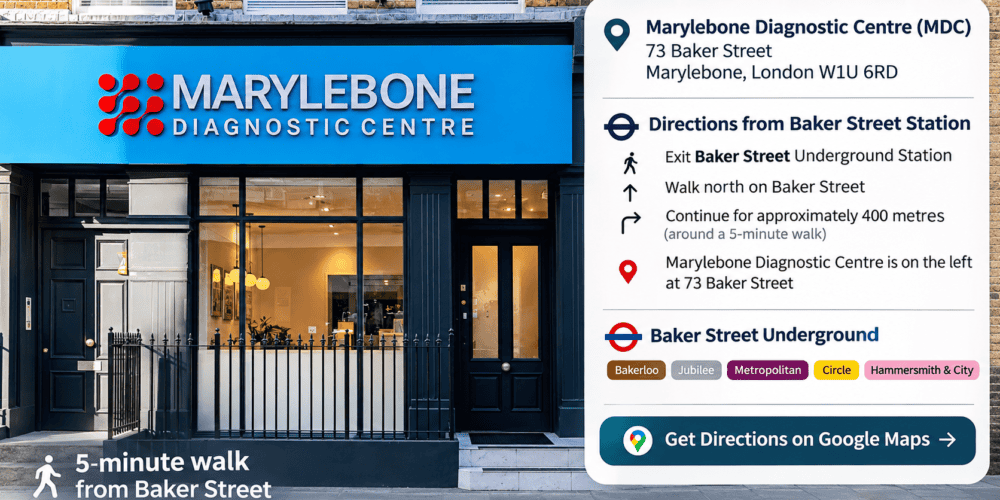
Marylebone Diagnostic Centre is a private diagnostic clinic located at 73 Baker Street in Marylebone, Central London.
MDC provides laboratory-based male and female fertility investigations and couples’ fertility assessment options, with access to relevant clinical advice and specialist pathways.
If you are searching for further fertility investigations in London after a normal semen analysis, our existing services include the following.
Couples’ Fertility Assessment
Explore assessment options for both partners rather than considering individual laboratory results in isolation.
View Assessment OptionsSemen Analysis
Laboratory assessment of semen and sperm characteristics using WHO-based reference criteria.
View Semen AnalysisMale Infertility Profile
Explore blood investigations relevant to selected male reproductive and hormonal health concerns.
View Male Fertility TestingFemale Fertility Assessment
Discover female fertility testing options, including relevant hormonal and ovarian reserve investigations.
View Female Fertility TestingSperm DNA Fragmentation
Information about the laboratory investigation, its limitations and considerations to discuss with your specialist before testing.
Learn About the TestUrology and Andrology
Explore assessment pathways for male reproductive health, sexual function and relevant urological concerns.
Explore Specialist ServicesHow much do further fertility investigations cost?
The total cost depends on which investigations have already been completed and which additional tests or consultations are clinically appropriate.
Review the current prices on our individual service pages or contact the MDC team for information about available fertility assessment packages.
Not every couple requires advanced fertility testing. Wherever possible, existing results should be considered before arranging additional investigations.
Frequently asked questions
Can my husband be infertile if his semen analysis is normal?
A normal semen analysis cannot establish fertility with certainty. Male reproductive health concerns may still require assessment, and investigation of both partners is important.
Why am I not getting pregnant when my husband’s sperm results are normal?
Possible explanations include ovulatory disorders, reproductive anatomy, age-related fertility changes, sexual health factors or conditions not identified through standard semen analysis. Sometimes no cause is found after initial investigation.
Should we automatically book a sperm DNA fragmentation test?
No. NICE’s 2026 fertility guideline recommends against sperm DNA fragmentation testing in its investigation pathway. Some international guidelines support selected indications, but a specialist should evaluate whether testing would meaningfully influence your care.
Can a man with normal sperm results have a hormonal problem?
Yes. Targeted hormonal assessment may be relevant when there are symptoms such as reduced libido, erectile dysfunction or other signs of an endocrine or reproductive health disorder.
Can an infection affect fertility without obvious symptoms?
Some reproductive tract infections can be asymptomatic. However, routine infection screening solely because conception has not occurred is not necessarily appropriate. Testing should reflect clinical history, symptoms and risk factors.
Should I repeat my semen analysis if the first result was normal?
Not necessarily. Repeat testing may be appropriate when collection was incomplete, the results were borderline, circumstances have changed or clinical assessment identifies a specific reason.
Can fertility blood tests detect blocked fallopian tubes?
No. Blood tests cannot establish whether the fallopian tubes are open. Specialist investigations such as hysterosalpingography or contrast ultrasound may be considered.
Can regular periods rule out female infertility?
No. Regular menstrual cycles are generally reassuring regarding ovulation, but cannot rule out every reproductive condition or problem affecting conception.
How can unexplained infertility be diagnosed?
The diagnosis may be considered after an appropriate assessment of both partners has not identified a recognised cause. A normal semen analysis alone is not sufficient to establish this diagnosis.
Where can couples have private fertility investigations in Central London?
Marylebone Diagnostic Centre provides private fertility testing and couples’ fertility assessment options at 73 Baker Street, Marylebone, London W1U 6RD.
Contact the clinic on 020 7724 0540 or WhatsApp 07495 970109 to discuss the available services.
Can I bring fertility test results from another clinic to Marylebone Diagnostic Centre?
You are encouraged to bring previous laboratory reports when arranging further assessment. Contact the team to confirm which consultation option is suitable for reviewing your results.
Continue exploring your fertility health
Understanding sperm DNA integrity
Learn why sperm concentration and DNA integrity represent different laboratory characteristics.
Read the articleHow long should couples try before fertility testing?
Understand when reproductive concerns may justify further medical investigation.
Read the articleUnderstanding AMH and ovarian reserve
Explore the role and limitations of AMH in female reproductive health.
Read the articleMale fertility testing options
Explore semen analysis, hormone assessment and other male reproductive investigations.
Read the articleMarylebone Diagnostic Centre
Marylebone Diagnostic Centre (MDC)73 Baker Street
Marylebone, London W1U 6RD
United Kingdom
Our Baker Street location is convenient for patients travelling from Marylebone, Paddington, Fitzrovia, Mayfair, St John’s Wood and the wider Central London area.
The clinic is accessible from Baker Street Underground station, with connections to the Metropolitan, Jubilee, Bakerloo, Circle and Hammersmith & City lines.
Telephone:
020 7724 0540
WhatsApp:
+44 7495 970109
Email:
info@marylebonelab.co.uk
Clinical references and further reading
This article draws on international laboratory standards and clinical fertility guidance. Recommendations may differ between countries and professional organisations.
- World Health Organization. WHO Laboratory Manual for the Examination and Processing of Human Semen. Sixth edition, 2021. Read WHO laboratory manual .
- National Institute for Health and Care Excellence. Fertility Problems: Assessment and Treatment. NICE guideline NG257, published 31 March 2026. Read guideline .
- NICE NG257. Investigation of Fertility Problems and Management Strategies. Includes recommendations on semen analysis, male fertility investigations and ovarian reserve. Read recommendations .
- NICE NG257. Rationale and Impact. Includes the evidence considerations underpinning recommendations on sperm DNA fragmentation. Read supporting rationale .
- American Urological Association and American Society for Reproductive Medicine. Diagnosis and Treatment of Infertility in Men: AUA/ASRM Guideline. Published 2020, amended 2024. Read guideline .
- European Association of Urology. Guidelines on Sexual and Reproductive Health. 2024 edition, male infertility section. Read guidance .
Understand your fertility results together.
If your semen analysis is normal but pregnancy has not occurred, the answer may not be another isolated laboratory test.
A coordinated assessment of both partners can help identify which investigations are relevant and when specialist advice is appropriate.
Contact Marylebone Diagnostic Centre to explore your next fertility assessment options at our Baker Street clinic in Central London.
Medical information disclaimer: This article is provided for general educational purposes. It does not establish a diagnosis, replace an individual medical consultation or guarantee fertility outcomes. Investigations and treatment decisions should be based on your individual circumstances and professional clinical advice.
Published by Marylebone Diagnostic Centre, 73 Baker Street, London W1U 6RD.