
Vitamin D Blood Test in London: 25-OH Testing, Results, Deficiency & Treatment
If you want to check your vitamin D level, the usual blood test is 25-hydroxyvitamin D, also written as 25(OH)D or Vitamin D 25-OH.
This guide explains what the vitamin D blood test is called, what it measures, who may benefit from testing, how results are interpreted, how much private testing costs at MDC, and when supplementation or further clinical assessment may be appropriate.
What is the vitamin D blood test called?
25-hydroxyvitamin D is the main circulating form used to assess vitamin D status.
This is different from 1,25-dihydroxyvitamin D, the biologically active form of vitamin D. The 1,25-dihydroxy test has more specialised uses and is not normally the test used simply to check whether your vitamin D stores are low.
25-OH Vitamin D vs 1,25-Dihydroxy Vitamin D: which test checks vitamin D levels?
| Test | What it is | Typical purpose |
|---|---|---|
|
25-hydroxyvitamin D 25(OH)D / Vitamin D 25-OH | The main circulating form of vitamin D. | The usual blood marker used to assess overall vitamin D status and investigate possible deficiency. |
| 1,25-dihydroxyvitamin D | The active hormonal form of vitamin D. | A more specialised test that may be requested in particular clinical situations. It is not a substitute for 25(OH)D when simply assessing vitamin D stores. |
The test you will usually be looking for is Vitamin D (25-OH).
Vitamin D blood tests and profiles at MDC
Marylebone Diagnostic Centre offers standalone vitamin D testing as well as broader vitamin and health profiles. Choose according to what you are trying to investigate rather than automatically ordering the largest panel.
Vitamin D (25-OH)
The usual blood test for assessing vitamin D status and investigating possible deficiency.
View Vitamin D 25-OH Test →Vitamin D (1,25 Dihydroxy)
A specialised vitamin D test used in particular clinical circumstances rather than routine assessment of vitamin D stores.
View Vitamin D Tests →Vitamin Profile
A broader profile for patients who want vitamin D assessed alongside vitamin B12 and folate.
View Vitamin Profile →Bone Profile 2
Combines vitamin D status with selected biochemical markers related to calcium and bone metabolism.
View MDC Tests & Profiles →If your main question is simply whether your vitamin D level is low, the standalone Vitamin D (25-OH) test is the usual starting point. Broader profiles may be useful when other nutritional or clinical questions also need investigation.
What does vitamin D do?
Vitamin D helps regulate calcium and phosphate and is important for maintaining healthy bones, teeth and muscles.
Prolonged or severe vitamin D deficiency can contribute to bone problems, including osteomalacia in adults.
Vitamin D is obtained from several sources, including sunlight exposure, diet and supplements.
Who may consider a vitamin D blood test?
Not everyone needs vitamin D blood testing. Testing may be useful when symptoms, medical history, risk factors or a clinical assessment raise concern about deficiency.
Possible clinical reasons
- Bone pain
- Muscle weakness
- Previous low vitamin D results
- Conditions affecting absorption
- Clinical concern about bone health
Higher-risk circumstances
- Very little exposure to sunlight
- Being housebound
- Usually covering most of the skin outdoors
- Darker skin
- Some medical conditions affecting vitamin D absorption or metabolism
What do vitamin D blood test results mean?
Vitamin D results are usually reported as a concentration of 25-hydroxyvitamin D in the blood, commonly in nmol/L in the UK.
The result should be considered alongside the laboratory’s reference guidance, your symptoms, medical history, medicines and supplements.
Depending on the result and your circumstances, a clinician may discuss supplementation, possible causes of deficiency and whether any further investigation or follow-up is appropriate.
Do I need a blood test before taking vitamin D?
Usually not for routine preventive supplementation.
NHS guidance advises adults and children over 4 to consider taking 10 micrograms (400 IU) of vitamin D daily during autumn and winter. Some people at higher risk of deficiency are advised to consider this throughout the year.
Testing becomes more relevant when deficiency is suspected, there are clinical risk factors, previous abnormal results, symptoms requiring assessment, or treatment decisions depend on knowing the actual level.
What happens if my vitamin D result is low?
Management depends on how low the result is, your medical history, symptoms, medicines, existing supplements and the possible reason for deficiency.
Oral vitamin D is usually the preferred treatment. The dose and duration may differ from routine preventive supplementation when deficiency has been confirmed.
Correcting a low vitamin D level does not guarantee that persistent fatigue, pain, weakness or other symptoms will resolve. Ongoing symptoms may require assessment for other causes.
What about vitamin D injections?
Intramuscular Vitamin D
An intramuscular (IM) injection delivers vitamin D into a muscle. It is not automatically required because a vitamin D blood result is low.
A clinician may consider an alternative to oral treatment in appropriate circumstances, for example when oral therapy is unsuitable or absorption is a significant clinical concern.
Suitability should be assessed using your vitamin D result, medical history, medicines and existing supplements.
View MDC IM InjectionsWhere can I get a private vitamin D test in London?
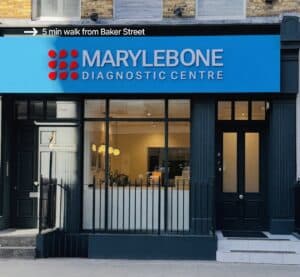
Marylebone Diagnostic Centre provides private vitamin D blood testing at 73 Baker Street, London W1U 6RD.
The standalone Vitamin D (25-OH) test is currently listed at £69. A GP referral is not required for private testing at MDC.
Choose the Vitamin D (25-OH) test rather than assuming the similarly named 1,25-dihydroxy test is the routine deficiency test.
Visit MDC for Vitamin D Testing
Quick Answers: Vitamin D Blood Testing
What is a vitamin D blood test called?
What is vitamin D called on a blood test?
What is the best blood test for vitamin D deficiency?
Is a serum vitamin D test the same as a 25-OH test?
What is a vitamin D blood test used for?
How much is a private vitamin D blood test?
Do I need to fast for a vitamin D blood test?
Do I need a vitamin D test before taking supplements?
What happens if my vitamin D result is low?
Does a low vitamin D result mean I need an injection?
Where can I get a vitamin D blood test in London?
Can I get a private vitamin D blood test without a GP referral?
Clinical sources & further reading
This article is provided for general educational purposes and does not replace individual medical advice, diagnosis or treatment.
Need a private vitamin D blood test in London?
MDC’s standalone Vitamin D (25-OH) blood test is currently £69. Private blood testing is available at Marylebone Diagnostic Centre, 73 Baker Street, London W1U 6RD.
View Vitamin D 25-OH Test Get Directions