Eggs, Follicles, and AMH
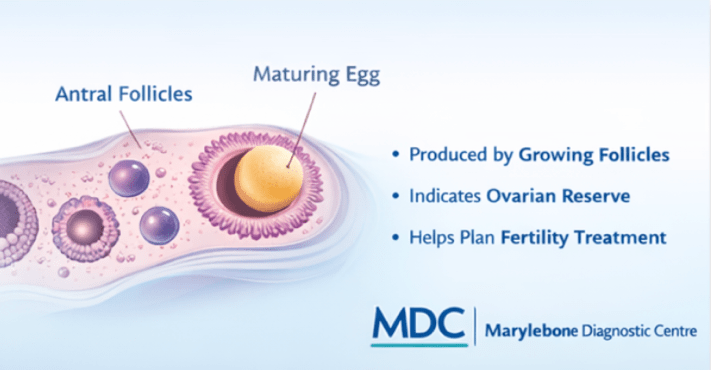
Eggs mature inside follicles. The number and health of these follicles influence fertility potential. Recent reproductive research shows that egg competence depends not just on age, but on:
- Follicular environment
- Hormonal coordination
- Cellular organisation during maturation
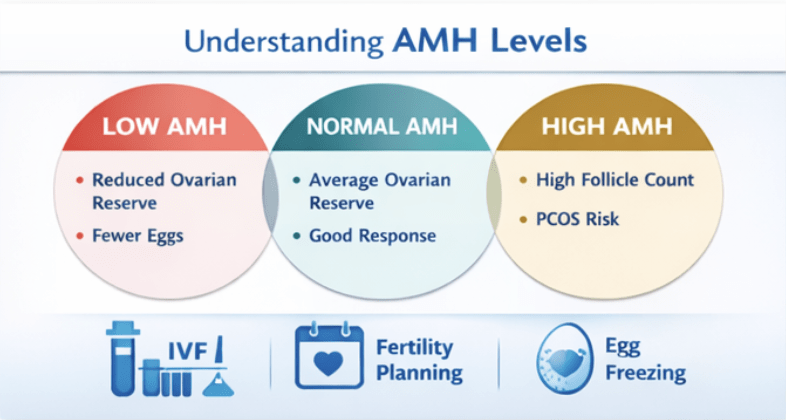
While AMH does not measure egg quality directly, studies consistently show that very low AMH is associated with reduced response to ovarian stimulation and fewer retrievable eggs during IVF. This is why AMH is central to fertility planning.
What AMH Can Tell You
- Ovarian reserve (egg supply trend) – AMH gives insight into remaining follicle pool, ovarian ageing trajectory, and likely response to fertility treatment.
- Fertility treatment planning – Clinicians use AMH to tailor IVF protocols, estimate stimulation response, and reduce risks such as over- or under-stimulation.
- Long-term fertility awareness – AMH is useful even before trying to conceive, especially for fertility preservation planning, women delaying pregnancy, and baseline reproductive health checks.
What AMH Cannot Tell You
This is where many people get misled. AMH does not:
- Predict natural conception on its own
- Measure egg quality or chromosomes
- Confirm ovulation
- Determine pregnancy success alone
Research has shown that women with low AMH can still conceive naturally, while high AMH does not guarantee fertility. Context is everything.
AMH and Egg Quality: The Honest Explanation
At a cellular level, egg quality depends on:
- Correct maturation
- Stable metabolic conditions
- Coordinated hormonal signalling
Studies in Human Reproduction and related journals show that these processes are hormonally regulated, not directly visible through blood tests. AMH reflects the quantity of eggs entering development, not the microscopic structures inside each egg. This is why AMH must be interpreted alongside other hormones.
AMH Is Most Powerful When Combined with Other Tests
- FSH & Estradiol – ovarian responsiveness
- LH – ovulatory signalling
- Progesterone – ovulation confirmation
- Thyroid hormones – cycle stability
Together, these provide a realistic picture of fertility health.
AMH in Special Situations
PCOS
Women with PCOS often have high AMH, reflecting many small follicles. This does not automatically mean better fertility and requires careful interpretation.
Age-related decline
AMH naturally declines with age, but the rate varies widely between individuals.
IVF planning
AMH helps personalise treatment, not predict success alone.
When Should You Consider an AMH Test?
- Trying to conceive
- Planning IVF or egg freezing
- Irregular cycles
- Want fertility clarity without assumptions
- Over 30 and planning ahead
Testing early allows informed decisions, not rushed ones.
How Marylebone Diagnostic Centre Uses AMH Testing
At Marylebone Diagnostic Centre, AMH testing is:
- Fast
- Discreet
- Clinically interpreted
We prioritise:
- Realistic expectations
- Patient education
- Evidence-based fertility assessment
Results are typically available within 24–42 hours, depending on the profile.
Book Now
Key Takeaway
AMH is the most useful fertility blood test in 2025 – when used correctly. It offers insight into ovarian reserve and fertility planning, but it is not a fertility verdict. Understanding AMH means understanding its limits.
Contact & Location
📍 Marylebone Diagnostic Centre
Private Fertility Blood Testing in Central London
73 Baker Street, London W1U 6RD
🚇 5-minute walk from Baker Street tube
⏱ Results within 24–42 hours
📞 +44 7495 970109
🌐 marylebonediagnosticcentre.com