
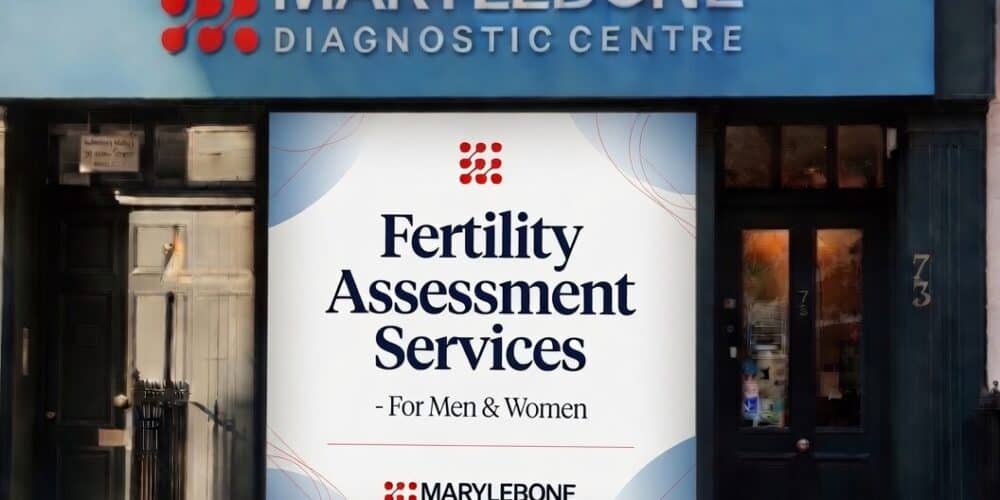
Couples Fertility Assessment in London
Before committing to IVF or other fertility treatment, it can help to understand the fertility picture for both partners.
A couples fertility assessment can help identify male, female or combined factors that may be affecting conception. At Marylebone Diagnostic Centre, the aim is to help couples understand their results, identify whether further investigation is appropriate, and decide on the most sensible next step.
A fertility assessment cannot tell every couple whether IVF will be required, but it can help clarify important male and female factors before making a major medical, emotional and financial decision.
Quick Answers About Fertility Assessment
Do we need IVF just because we have not conceived yet?
Not necessarily. Difficulty conceiving can have many causes, and IVF is only one possible pathway. A structured fertility assessment may identify male, female or combined factors that can be investigated before deciding whether assisted reproduction is appropriate.
Should both partners be tested?
Yes. Fertility is best considered as a couple rather than assessing one partner in isolation. Male factors can contribute to fertility difficulties, while female assessment may consider ovarian reserve, ovulation, hormones, pelvic health and other relevant factors.
What fertility tests can be done before IVF?
Depending on the couple, assessment may include semen analysis, sperm DNA fragmentation testing where appropriate, reproductive hormones, ovarian reserve markers such as AMH, thyroid testing, prolactin and other targeted investigations based on clinical history.
Can MDC assess both male and female fertility?
MDC can provide fertility investigations for both partners and help coordinate the next stage of assessment. Where specialist input is needed, patients can be directed towards appropriate andrology, urology or gynaecology review.
When should we consider seeing a gynaecologist?
Gynaecology assessment may be useful where there are concerns such as irregular periods, pelvic pain, suspected endometriosis, previous pelvic surgery, recurrent pregnancy loss or possible problems with ovulation or reproductive anatomy.
When should the male partner see an andrologist or urologist?
Specialist male fertility assessment may be appropriate where semen parameters are abnormal, there is a history of testicular problems, varicocele, sexual dysfunction, hormonal concerns, previous surgery or persistently unexplained infertility.
Can semen analysis alone tell us whether IVF is needed?
No. Semen analysis provides important information about sperm concentration, movement and morphology, but fertility decisions should consider the couple as a whole. In selected cases, additional testing such as sperm DNA fragmentation may provide further information.
What is sperm DNA fragmentation and why might it matter?
Sperm DNA fragmentation assesses damage within sperm DNA that is not measured by a routine semen analysis. It may be considered in selected fertility cases, particularly where there is unexplained infertility, recurrent pregnancy loss, abnormal semen parameters or previous assisted-conception failure.
What does AMH tell us?
Anti-Müllerian hormone, or AMH, is commonly used as a marker of ovarian reserve. It can provide useful information about the remaining follicle pool, but it does not by itself determine whether someone can conceive naturally.
Does a low AMH mean IVF is the only option?
No. A low AMH result should be interpreted alongside age, menstrual history, ultrasound findings and other clinical information. It may influence fertility planning, but it should not automatically be interpreted as meaning IVF is the only possible route.
Can fertility problems sometimes be managed without IVF?
Yes. Depending on the cause, management may include treatment of hormonal disorders, addressing relevant infection or inflammation, management of certain male-factor conditions, ovulation support, lifestyle changes or other specialist treatment. IVF remains an important option, but it is not the first or only answer for every couple.
When is IVF likely to be discussed?
IVF may be considered where there are significant fertility factors, prolonged infertility, tubal disease, severe male-factor infertility, reduced reproductive time because of age, or where other approaches have not been successful. The decision should be individualised.
Can MDC help us understand our results before we approach an IVF clinic?
Yes. MDC can help couples organise appropriate investigations, understand what their results show, identify whether specialist review is needed and approach any later IVF consultation with much clearer information.
Why assess fertility before moving straight to IVF?
IVF can be an important and highly effective fertility treatment, but it is also a major medical, emotional and financial commitment. Before starting treatment, it is reasonable to understand whether there are identifiable fertility factors affecting either partner.
- Is there an identifiable male fertility factor?
- Are there female hormonal or gynaecological factors?
- Does ovarian reserve need further assessment?
- Are semen parameters abnormal or borderline?
- Would sperm DNA fragmentation testing add useful information?
- Is specialist andrology or gynaecology review appropriate?
- Is IVF genuinely the most logical next step?
How MDC can support both partners
Male Fertility Pathway
Male assessment may include semen analysis, reproductive hormones and additional testing where clinically appropriate.
Where abnormal findings or more complex concerns are identified, specialist andrology or urology review may be considered.
Female Fertility Pathway
Female assessment may include ovarian reserve markers, reproductive hormones, thyroid testing and other investigations based on clinical history.
Where appropriate, patients can be directed towards specialist gynaecology assessment.
Couples Fertility Review
Looking at both partners together can provide a clearer understanding of the fertility picture and help identify which investigations or referrals are most relevant.
Before Assisted Conception
If IVF, ICSI or another assisted-conception pathway is later recommended, having appropriate baseline investigations already completed can make discussions with a fertility specialist more informed.
What might a couples fertility assessment include?
The exact investigations should be guided by the couple’s history and clinical needs, but may include:
- Semen analysis
- Sperm DNA fragmentation testing where appropriate
- Male reproductive hormone testing
- AMH and ovarian reserve testing
- Female reproductive hormones
- Thyroid function
- Prolactin
- Additional blood tests based on clinical history
- Specialist gynaecology review where indicated
- Specialist andrology or urology review where indicated
The appropriate investigations vary between patients. Not every test is required for every couple.
When should you consider fertility assessment?
Couples may wish to seek fertility assessment where conception is taking longer than expected, where there is a known reproductive-health concern, or where they simply want a clearer understanding before making decisions about assisted fertility treatment.
Age, duration of trying to conceive, previous pregnancies, menstrual history, semen parameters and medical history can all influence what the next step should be.
A clearer picture before a major fertility decision
Fertility care should not begin with an assumption that every couple needs IVF. Equally, fertility assessment should not delay appropriate referral where assisted conception is clearly indicated.
The purpose of assessment is to help couples understand the available information, identify important male and female factors and move towards the most appropriate next step with greater clarity.
Ready to understand your fertility picture?
Speak with the Marylebone Diagnostic Centre team about a couples fertility assessment in Central London.
Book a Fertility Assessment WhatsApp MDC