Why Am I Not Getting Pregnant? Common Fertility Issues Explained
Trying for a baby can feel exciting at first. However, when pregnancy does not happen as expected, many couples begin asking difficult questions.
Why is it taking longer?
Is something wrong?
Should we get tested?
In reality, fertility problems are more common than many people realise. According to the NHS, around 1 in 7 couples may experience difficulty conceiving naturally.
Sometimes the issue is simple and temporary. In other cases, hormone imbalance, ovulation problems, sperm quality, lifestyle factors, or underlying medical conditions may affect fertility.
The good news is that modern fertility blood testing and early fertility assessment can often identify problems earlier than expected.
At Marylebone Diagnostic Centre, we offer comprehensive fertility and ovulation testing in Central London designed to help patients better understand their reproductive health.
You can learn more about our fertility pathway here:
➡️ Pregnancy, Ovulation & Early Fertility Testing London
What Is Considered Infertility?
Infertility usually means not becoming pregnant after:
- 12 months of regular unprotected intercourse
- 6 months if the woman is over 35 years old
However, many patients seek testing much earlier, especially when symptoms or medical history suggest an underlying issue.
Early testing can provide reassurance or identify problems before they become more complicated.
Common Reasons Pregnancy May Not Happen
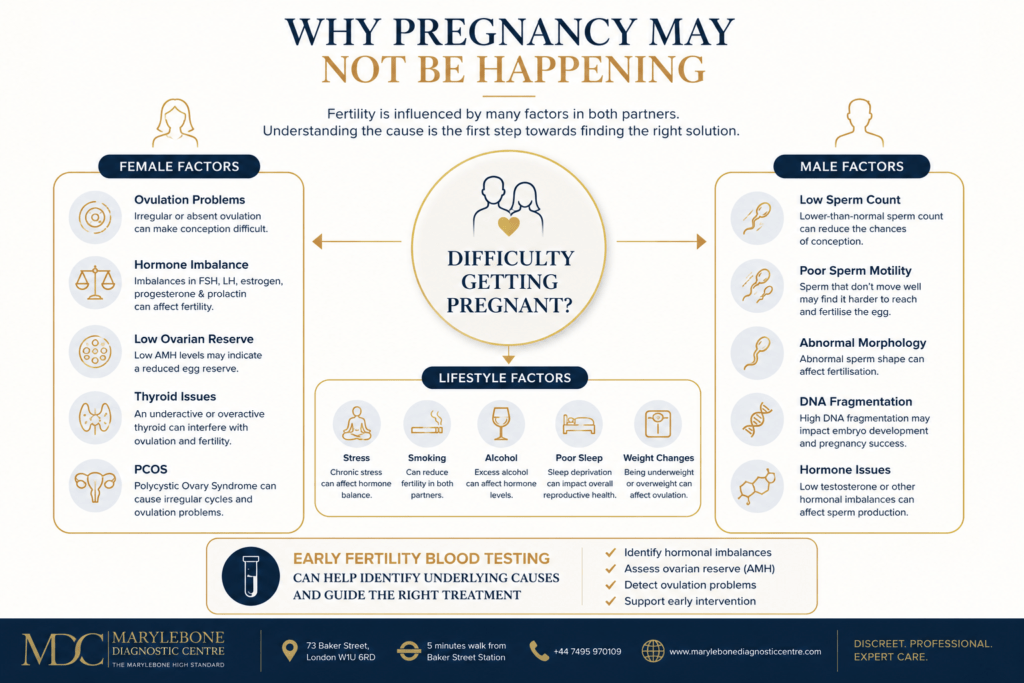
Fertility is affected by many systems within the body. Even small hormonal changes may interfere with conception.
Ovulation Problems
Ovulation is one of the most common causes of fertility difficulty.
If ovulation does not happen regularly, pregnancy becomes less likely.
Common ovulation-related issues include:
- Irregular menstrual cycles
- PCOS
- Hormone imbalance
- Thyroid dysfunction
- Low ovarian reserve
- Excess stress
- Significant weight changes
Women sometimes assume they are ovulating normally because they still have periods. However, this is not always the case.
Our:
➡️ Pregnancy, Ovulation & Early Fertility Testing London
pathway includes blood markers that help assess whether ovulation is occurring properly.
Hormone Imbalance and Fertility
Hormones play a major role in reproductive health.
Even mild hormonal abnormalities may affect:
- Egg development
- Ovulation
- Implantation
- Menstrual regularity
- Libido
- Pregnancy success
Important fertility hormones include:
- FSH
- LH
- Oestradiol
- Progesterone
- Prolactin
- AMH
- Thyroid hormones
Many patients discover underlying hormone imbalance through targeted fertility blood testing.
You can also explore our:
- Women’s Health Services
- AMH Fertility Testing
Could Low Ovarian Reserve Be Affecting Fertility?
Ovarian reserve refers to the estimated number of remaining eggs.
While egg quantity does not guarantee pregnancy, reduced ovarian reserve may affect fertility planning.
Age is one factor, but ovarian reserve can vary significantly between individuals.
An AMH blood test may help provide insight into ovarian reserve.
Patients often consider testing when:
- planning pregnancy later in life
- preparing for IVF
- experiencing irregular cycles
- concerned about declining fertility
Our:
➡️ Pregnancy, Ovulation & Early Fertility Testing London
service can support early fertility assessment and hormone evaluation.
Male Fertility Also Matters
Fertility is not only a female issue.
Male factors contribute to a significant percentage of fertility difficulties.
Common male fertility issues include:
- low sperm count
- poor motility
- abnormal morphology
- sperm DNA fragmentation
- hormone imbalance
- lifestyle factors
At MDC, we also offer:
This allows couples to investigate fertility together rather than focusing on only one partner.
Symptoms That May Suggest Fertility Problems
Some fertility issues develop silently. Others may produce symptoms.
Possible warning signs include:
- irregular periods
- absent periods
- severe acne or excess hair growth
- pelvic pain
- painful periods
- recurrent miscarriage
- unexplained fatigue
- low libido
- erectile dysfunction
- history of STDs
- previous pelvic infections
Even without symptoms, fertility blood testing may still be useful.
What Tests Are Commonly Used for Fertility Assessment?
A fertility assessment may involve several investigations depending on symptoms and medical history.
Common fertility blood tests include:
- AMH
- FSH
- LH
- Progesterone
- Oestradiol
- Prolactin
- Thyroid profile
- Vitamin D
- Iron studies
In men:
- semen analysis
- DNA fragmentation testing
- testosterone profile
You can explore fertility-focused testing here:
➡️ Pregnancy, Ovulation & Early Fertility Testing London
Can Lifestyle Affect Fertility?
Yes.
Lifestyle may significantly influence reproductive health in both men and women.
Factors include:
- smoking
- alcohol
- obesity
- chronic stress
- sleep quality
- poor nutrition
- steroid use
- drug use
- excessive exercise
Even vitamin deficiencies may contribute to fertility concerns.
Related testing:
- Vitamin Profile Testing London
- Private Blood Testing London
Why Early Fertility Testing Matters
Many couples wait too long before seeking answers.
Early testing may:
- identify treatable problems
- improve fertility planning
- reduce stress and uncertainty
- support IVF preparation
- provide reassurance
- guide lifestyle adjustments
Some patients discover fertility issues very early. Others receive reassurance that everything appears normal.
Both outcomes can be valuable.
Why Choose Marylebone Diagnostic Centre?
At Marylebone Diagnostic Centre, we provide fertility-focused testing pathways in the heart of Central London.
Patients choose MDC because we offer:
- Central London location
- 5-minute walk from Baker Street station
- discreet and confidential care
- fast turnaround times
- same-week availability
- fertility-focused pathways
- comprehensive blood testing
- couples’ fertility support
- advanced sperm DNA fragmentation testing
We also maintain the Marylebone High Standard using quality assurance systems aligned with modern laboratory practice.
Related Fertility Services
You may also find these services useful:
- Pregnancy, Ovulation & Early Fertility Testing London
- Couples Fertility Assessment
- Semen Analysis London
- DNA Fragmentation Test London
- Women’s Health Testing
FAQs
How do I know if I am ovulating?
Blood testing and hormone monitoring may help determine whether ovulation is occurring properly.
When should I get fertility testing?
Many specialists recommend testing after 12 months of trying naturally, or after 6 months if over 35.
Can blood tests detect fertility problems?
Blood tests may identify hormone imbalance, ovulation problems, thyroid dysfunction, and ovarian reserve concerns.
Does stress affect fertility?
Chronic stress may influence hormones, menstrual cycles, libido, and overall reproductive health.
Is fertility testing only for women?
No. Male fertility plays a major role in conception, and semen analysis is often recommended alongside female testing.
Book Fertility Testing in London
If you are concerned about fertility, ovulation, or hormone imbalance, early assessment may help provide clarity.
Learn more here:
➡️ Pregnancy, Ovulation & Early Fertility Testing London
📍 Marylebone Diagnostic Centre
73 Baker Street, London W1U 6RD
🚶 5-minute walk from Baker Street station
📞 +44 7495 970109
🕒 Monday–Saturday, 8:00–16:00