
Semen Analysis Results Chart UK: Understand Your Sperm Test
Have you received your semen analysis results and wondered whether your sperm count, motility or morphology is normal?
Perhaps your report says your sperm concentration is 12 million/mL, your progressive motility is 25%, or your morphology is 3%. What do those numbers actually mean?
At Marylebone Diagnostic Centre (MDC), we help men understand their reproductive health through semen analysis, sperm DNA fragmentation testing and fertility assessments at our Baker Street clinic in London.
Quick Answer: What is a normal semen analysis result?
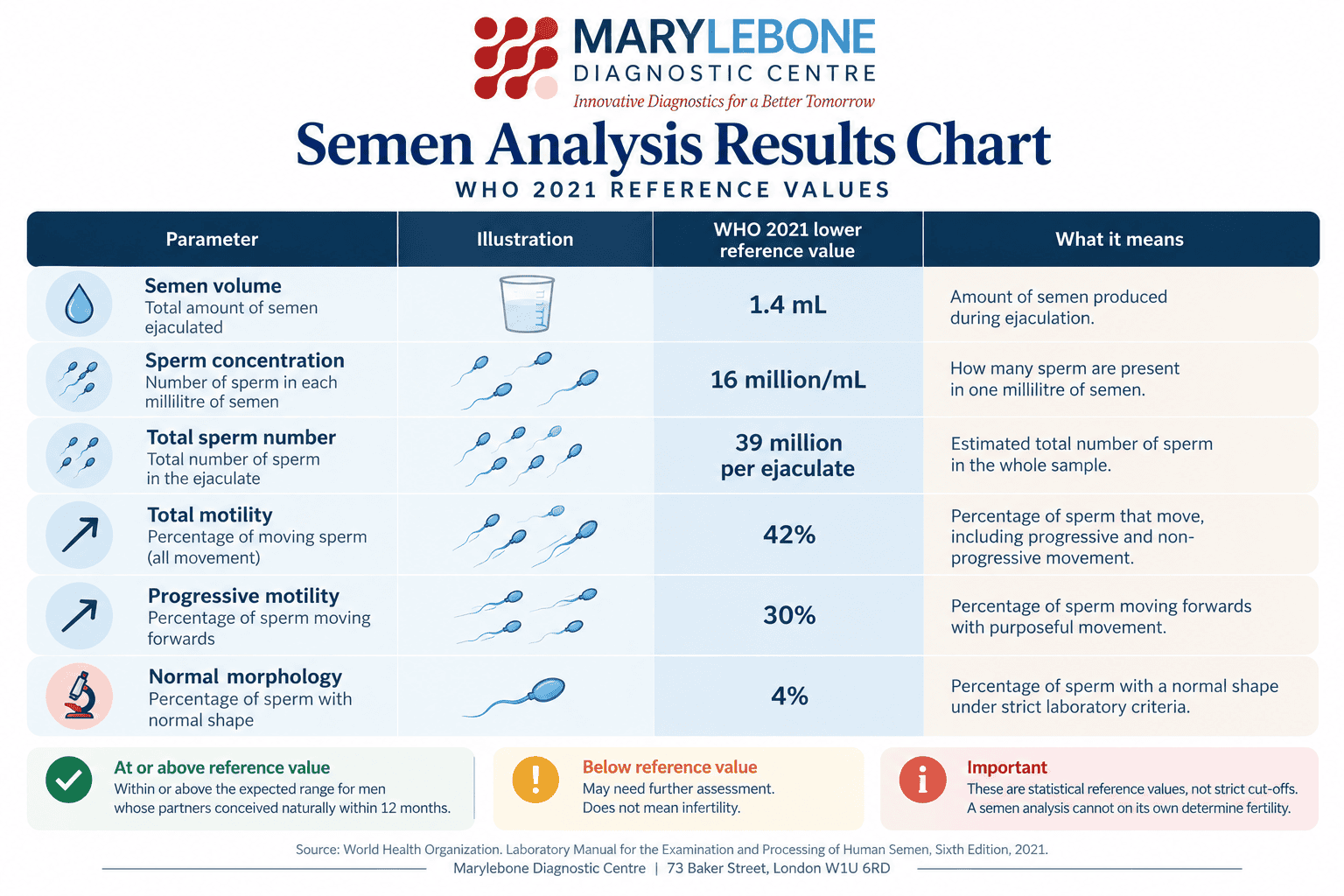
According to the World Health Organization (WHO) sixth edition, the lower reference values include sperm concentration of 16 million/mL, progressive motility of 30%, total motility of 42% and normal morphology of 4%.
These figures are based on results from men whose partners conceived naturally within 12 months. They are not strict boundaries between fertile and infertile men.
A result below a reference value does not automatically mean infertility. A result above it does not guarantee pregnancy.
Semen Analysis Results Chart — WHO 2021
WHO sixth-edition lower fifth-percentile reference values, 2021.
| Measurement | WHO lower reference value | What it tells you |
|---|---|---|
| Semen volume | 1.4 mL | Amount of semen produced |
| Sperm concentration | 16 million/mL | Number of sperm per millilitre |
| Total sperm number | 39 million per ejaculate | Total number of sperm in the sample |
| Total motility | 42% | Percentage of sperm moving |
| Progressive motility | 30% | Percentage moving forwards |
| Normal morphology | 4% | Percentage with normal shape |
| Vitality | 54% | Percentage of living sperm |
What do the numbers mean?
Sperm concentration
This tells you how many sperm are present in each millilitre of semen.
For example, 20 million/mL means approximately 20 million sperm in one millilitre.
Total sperm number
This tells you how many sperm are present in the entire ejaculate.
It depends on both semen volume and sperm concentration.
Sperm motility
This measures how many sperm are moving.
Progressive motility describes sperm moving forwards. Total motility includes progressive and non-progressive movement.
Sperm morphology
This measures the proportion of sperm with a normal shape under strict laboratory assessment criteria.
A morphology result of 4% does not mean that 96% of sperm are dead.
Semen volume
This measures the total fluid produced during ejaculation.
An unexpectedly low result may require repeat testing, particularly if part of the sample was lost during collection.
Sperm vitality
This measures how many sperm are alive. It can be particularly useful when motility is very low.
Worried About Your Semen Colour?
Semen is usually white or greyish-white, but it can sometimes appear clear, yellow, greenish, pink or brown. Colour alone cannot confirm or exclude an STI, infection or fertility problem, and it cannot reliably tell you your sperm count. A laboratory semen analysis is needed to measure sperm concentration, motility and morphology.
We explain what each semen colour may mean in a separate guide.
Is My Sperm Count Normal?
A sperm concentration of 16 million/mL is the WHO lower reference value. But sperm concentration is only one part of a semen analysis. For example:
- 25 million/mL: above the WHO lower reference value.
- 16 million/mL: at the lower reference value.
- 10 million/mL: below the lower reference value.
- No sperm detected: requires further laboratory and clinical assessment.
A lower count does not automatically mean pregnancy is impossible. A clinician should consider the full semen analysis, medical history and the fertility of both partners.
What Does Low Sperm Motility Mean?
Sperm motility describes how sperm move. Progressive motility is particularly important because sperm need to travel towards the egg.
The WHO lower reference value for progressive motility is 30%. If your report shows 25%, this is below the reference value, but it does not establish infertility.
Your sperm count, total motility, morphology and fertility history all matter.
Is 3% Sperm Morphology Bad?
A morphology result of 3% is below the WHO lower reference value of 4%. However, morphology should never be used alone to decide whether a man can conceive.
Some men with low morphology achieve natural pregnancies. If morphology is consistently low, your clinician may recommend further assessment.
What Do Abnormal Semen Analysis Terms Mean?
Your report may use medical terminology. These describe laboratory findings. They do not identify the cause by themselves.
| Term | Meaning |
|---|---|
| Oligozoospermia | Low sperm concentration |
| Asthenozoospermia | Reduced sperm motility |
| Teratozoospermia | Low percentage of normal sperm forms |
| Azoospermia | No sperm detected following appropriate laboratory examination |
| Oligoasthenoteratozoospermia (OAT) | Low concentration, motility and morphology together |
If your report shows azoospermia or a very low sperm count, specialist assessment is important.
Can I Have Normal Semen Analysis Results but Still Have Fertility Problems?
Yes. A standard semen analysis measures several important aspects of sperm health, but it cannot evaluate every factor involved in conception. Fertility also depends on the other partner’s reproductive health. In selected cases, additional investigations may be appropriate.
What about sperm DNA fragmentation?
Sperm DNA fragmentation testing assesses damage to the genetic material inside sperm. It is different from a standard semen analysis.
A man may have sperm concentration, motility and morphology within the reference ranges but still have increased DNA fragmentation. However, DNA fragmentation testing is not required for everyone. Its usefulness depends on the clinical circumstances.
What Should I Do If My Semen Analysis Is Abnormal?
Do not assume that one abnormal result means you cannot have children. Semen parameters can vary between samples. Recent illness, fever, medications, incomplete sample collection and other factors may influence the findings.
Depending on your results, the next steps may include:
- Repeating the semen analysis.
- Reviewing medical history and lifestyle factors.
- Considering hormone blood tests where appropriate.
- Assessing possible underlying causes.
- Referral to a fertility specialist or urologist.
- Considering additional sperm testing when clinically indicated.
NICE recommends a repeat confirmatory semen analysis after an abnormal initial result, ideally around three months later. Where severe sperm deficiency or azoospermia is detected, repeat testing should be arranged sooner.
How Do I Prepare for a Semen Analysis?
Preparation can affect your results. Before testing:
- Follow MDC’s abstinence instructions for your booked test.
- Tell the team about recent illness or fever.
- Mention any testosterone treatment, anabolic steroids or relevant medication.
- Use the collection container provided or approved by the clinic.
- Inform the laboratory if part of the sample was lost.
- Follow the collection and transport instructions carefully.
- Do not stop prescribed medication without speaking to your clinician.
Semen Analysis and Fertility Testing at MDC
Marylebone Diagnostic Centre provides in-house semen analysis at its Baker Street clinic. Depending on your circumstances, you may need a standard semen analysis, further male fertility testing or a wider couples’ assessment.
Standard Semen Analysis
Measures important sperm and semen parameters, including concentration, motility, morphology and volume.
Male Fertility Testing
For patients who need additional investigations, including sperm DNA fragmentation where appropriate.
Couples Fertility Assessment
For couples who want a wider assessment of possible fertility concerns.
Sexual Health Testing
If symptoms or exposure suggest a possible sexually transmitted infection, appropriate STI testing may be needed.
Urology and Specialist Assessment
If you have persistent abnormal semen results, testicular symptoms, suspected varicocele or other concerns, a specialist assessment may be appropriate. Contact MDC to discuss available referral pathways.
Frequently Asked Questions About Semen Analysis Results
What is a normal sperm count for pregnancy?
Is 20 million sperm count normal?
Is 30% sperm motility normal?
Can I get pregnant with low sperm motility?
Is 4% sperm morphology normal?
Can I have children with 2% sperm morphology?
Can sperm count improve naturally?
Can testosterone injections affect fertility?
Can stress affect sperm quality?
Can smoking affect sperm quality?
Does age affect sperm quality?
Can semen analysis detect an STI?
What is sperm DNA fragmentation?
How many days should I abstain before semen analysis?
How long does a semen analysis take?
How much does a semen analysis cost in London?
Where can I book a private semen analysis in London?
Understand Your Results. Take the Next Step.
Your semen analysis is an important part of understanding your reproductive health, but it is only one part of the picture.
Whether you want to check your sperm count, investigate a fertility concern or understand an existing report, MDC can help you access appropriate testing and further assessment.
Medical References
- World Health Organization. WHO Laboratory Manual for the Examination and Processing of Human Semen. Sixth edition, 2021.
- NICE. Fertility Problems: Assessment and Treatment. NG257, 2026.
- European Association of Urology. Male Infertility Guidelines.
- Manchester University NHS Foundation Trust. Andrology Reference Ranges.
Medical note: This page provides general information and does not replace clinical assessment. Semen analysis results must be interpreted alongside the patient’s medical history, sample collection conditions and wider fertility circumstances.

