
Testosterone Levels by Age Chart UK: What Is Normal, and When Should You Consider TRT?
Are you feeling more tired than usual, noticing a lower sex drive or wondering whether your testosterone levels are normal for your age?
Perhaps you have already received a testosterone blood test showing 8, 10, 12 or 15 nmol/L and want to understand what the result means.
At Marylebone Diagnostic Centre (MDC), we help men investigate hormonal health through private blood testing and access to appropriate men’s health assessment pathways.
This guide explains your testosterone results, how levels change with age, when testosterone replacement therapy (TRT) may be considered and what to do next.
Quick Answer: What is a normal testosterone level?
In the UK, testosterone is usually measured in nmol/L.
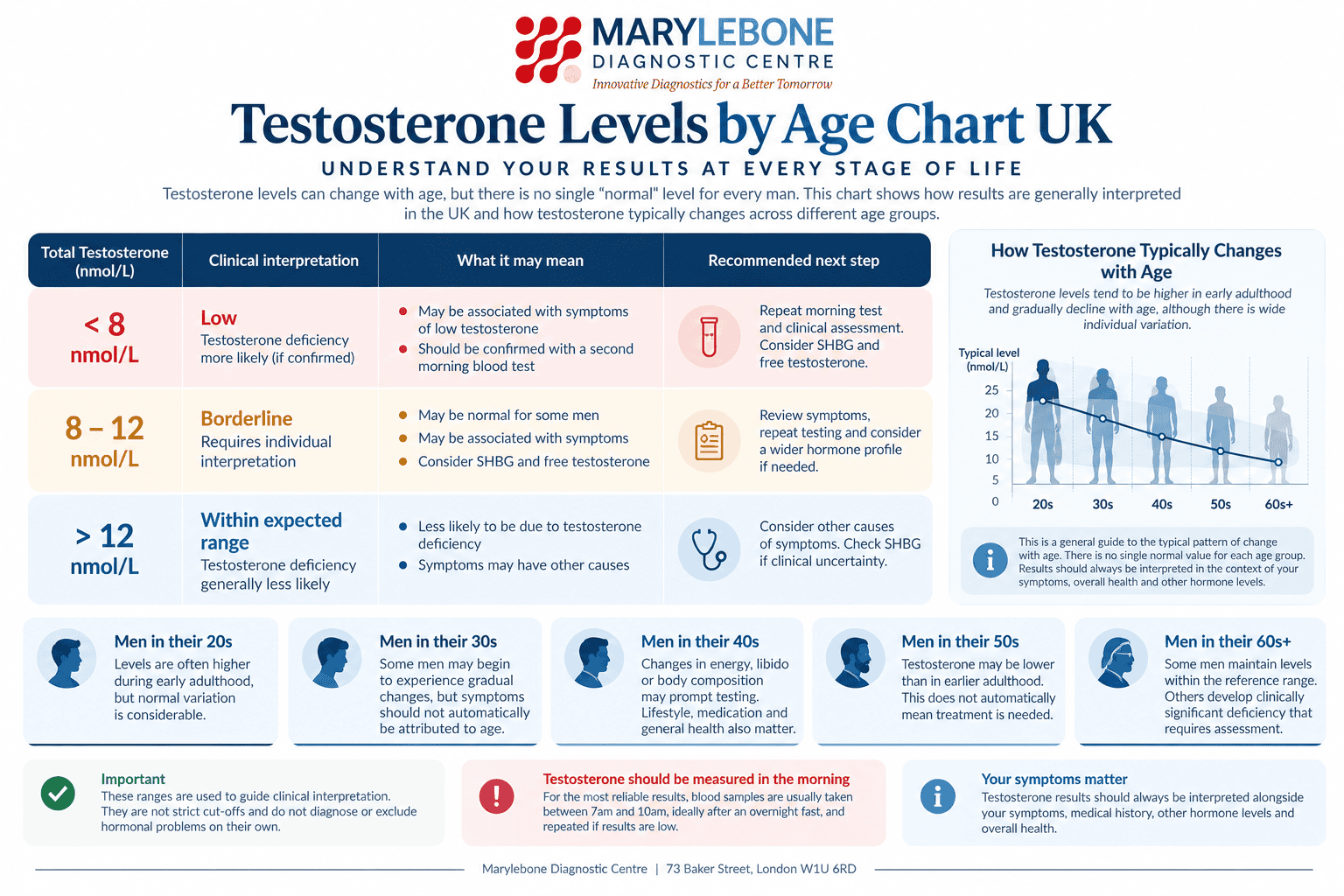
A result below 8 nmol/L may support testosterone deficiency when relevant symptoms are present, and a second properly timed morning blood test confirms the finding.
Results between 8 and 12 nmol/L require closer interpretation. Above 12 nmol/L, testosterone deficiency is generally less likely.
These are clinical decision ranges, not absolute rules or separate age-specific reference ranges.
Testosterone Levels Chart UK
| Total testosterone | What the result may mean | Next step |
|---|---|---|
| Below 8 nmol/L | Testosterone deficiency is more likely | Repeat morning testing and clinical assessment |
| 8–12 nmol/L | Borderline result | Review symptoms, SHBG and calculated free testosterone where appropriate |
| Above 12 nmol/L | Testosterone deficiency is generally less likely | Investigate other causes of symptoms if necessary |
Chart note: These values help guide clinical interpretation. They do not establish a diagnosis or determine whether TRT is appropriate on their own.
What do 8, 10, 12 and 15 nmol/L mean?
Is 8 nmol/L low testosterone?
A confirmed result below 8 nmol/L may support a diagnosis of testosterone deficiency, particularly if you have reduced libido, fewer morning erections or other relevant symptoms.
Is 10 nmol/L low testosterone?
Ten nmol/L is a borderline result. Further assessment may be appropriate, especially if symptoms persist.
Is 12 nmol/L normal?
Twelve nmol/L is close to an important clinical decision threshold. The result should be interpreted alongside your symptoms and other hormone measurements.
Is 15 nmol/L a good testosterone level?
For many adult men, 15 nmol/L falls within the expected laboratory range. However, one number cannot explain every symptom.
Testosterone Levels by Age
Testosterone levels often change as men get older. However, ageing does not automatically mean testosterone deficiency.
Men in their 20s
Testosterone levels are often relatively high during early adulthood, but normal variation is considerable.
Men in their 30s
Some men begin to experience gradual changes in testosterone. Symptoms should not automatically be attributed to age.
Men in their 40s
Changes in libido, energy or body composition may prompt questions about testosterone. Sleep, weight, medication and other medical conditions also matter.
Men in their 50s
Testosterone may be lower than in earlier adulthood. This does not automatically mean treatment is necessary.
Men in their 60s and beyond
Some men maintain testosterone within the reference range. Others develop clinically significant deficiency that requires investigation.
What Are the Symptoms of Low Testosterone?
The symptoms men commonly ask about include:
- Reduced sex drive.
- Fewer morning erections.
- Erectile difficulties.
- Reduced muscle mass or strength.
- Changes in body composition.
- Persistent tiredness.
- Low mood or reduced motivation.
- Reduced bone density in some cases.
Reduced libido and fewer spontaneous erections are more suggestive of testosterone deficiency than tiredness alone. Other medical conditions can cause similar symptoms.
If symptoms are affecting your daily life, appropriate testing and clinical assessment may help identify the cause.
Testosterone Replacement Therapy (TRT): Could It Help?
Testosterone replacement therapy is a medical treatment for selected men with confirmed testosterone deficiency. It may be considered when a man has relevant symptoms and appropriately repeated blood tests support the diagnosis.
TRT is not simply a treatment for ageing, tiredness or wanting to improve gym performance.
What is TRT?
TRT involves prescribing testosterone to replace insufficient hormone production. Treatment can be delivered through different formulations, such as gels or injections, depending on the clinical circumstances and prescribing service.
Who may be suitable for TRT?
A clinician may consider TRT when:
- Symptoms are consistent with testosterone deficiency.
- Low testosterone has been confirmed through appropriate testing.
- Possible underlying causes have been assessed.
- Treatment benefits and risks have been discussed.
- Fertility plans and relevant contraindications have been considered.
What benefits might TRT provide?
In appropriately selected men, treatment may improve certain symptoms, particularly sexual desire. Effects on energy, mood, muscle strength and other outcomes vary.
TRT does not guarantee improved erections or resolve every symptom.
What are the risks of TRT?
Potential concerns include raised haematocrit, acne, breast symptoms, worsening of some pre-existing conditions and suppression of sperm production.
Treatment requires appropriate clinical monitoring.
What happens before starting TRT?
Assessment may include repeat morning testosterone testing, additional hormone measurements, medical history, examination and relevant baseline safety investigations.
Does MDC offer a TRT pathway?
MDC’s dedicated TRT page explains its testosterone blood testing and monitoring service. Treatment suitability must be established clinically.
Already Taking TRT? What Blood Tests May Be Needed?
Men already receiving testosterone treatment need a different testing pathway from men investigating possible low testosterone for the first time.
Monitoring may include:
- Testosterone levels.
- Full blood count and haematocrit.
- PSA where appropriate.
- Other investigations according to treatment, symptoms and medical history.
The timing of blood collection can depend on whether testosterone is taken as a gel or injection.
Do not change your dose based solely on an online chart.
Can TRT Affect Fertility?
Yes. This is one of the most important questions men should ask before starting testosterone treatment.
External testosterone can suppress the hormones that stimulate sperm production. Some men receiving TRT develop very low sperm counts or no sperm in the ejaculate.
If you are planning to have children, discuss this before starting treatment. MDC offers semen analysis and additional male fertility investigations where appropriate.
Low Testosterone and Erectile Dysfunction
Low testosterone can contribute to reduced sexual desire and erectile difficulties. However, many men with erectile dysfunction have testosterone levels within the normal laboratory range.
Erection problems can also involve blood circulation, diabetes, cardiovascular health, medication and psychological factors.
Which MDC service should I consider?
If your main symptom is reduced libido, a testosterone profile may be a reasonable starting point. If your main concern is difficulty achieving or maintaining erections, a wider erectile dysfunction assessment may be more appropriate.
MDC provides an Erectile Dysfunction / Impotence Blood Profile, specialist assessment pathways and focused shockwave therapy for selected patients.
Total Testosterone, Free Testosterone and SHBG
Total testosterone
Measures testosterone circulating in your blood, including testosterone bound to proteins.
Free testosterone
Refers to testosterone that is not bound to circulating proteins. Calculated free testosterone may be useful when total testosterone is borderline or SHBG is abnormal.
SHBG
Sex hormone-binding globulin binds testosterone and influences how much is available in different forms.
LH and FSH
These hormones help regulate testicular function. They may be measured when investigating why testosterone is low.
Prolactin
A hormone that may be relevant when assessing selected hormonal or sexual symptoms.
Not every patient needs every test.
When Should You Have a Testosterone Blood Test?
Testing for suspected testosterone deficiency is generally best performed:
- In the morning.
- After fasting when following diagnostic guidance.
- When you are not acutely unwell.
- With a repeat sample if the first result is low.
Testosterone can fluctuate during the day and between testing occasions. Tell the clinic about medications, recent illness, nightshift work and any testosterone treatment you already take.
Which MDC Service Is Right for You?
“I want to check my testosterone level.”
Start with MDC’s Testosterone Profile.
“My testosterone is low. Could TRT help?”
Learn what TRT involves and how MDC supports testosterone blood testing and monitoring.
“I’m already on TRT and need monitoring.”
Review the available testosterone and safety-monitoring blood tests.
“I’m having erection problems.”
Explore the wider ED investigation pathway.
“I’m worried about my fertility.”
Start with semen analysis or appropriate male fertility testing.
“I need to speak with a specialist.”
Learn about urology and andrology assessment.
Frequently Asked Questions
What is a normal testosterone level for a 30-year-old man?
What is normal testosterone for a 40-year-old man?
What is normal testosterone for a 50-year-old man?
Is 10 nmol/L low testosterone?
Is 15 nmol/L normal?
Can I have low testosterone with normal blood results?
Can low testosterone cause erectile dysfunction?
Can TRT improve erectile dysfunction?
Does TRT increase muscle mass?
Can TRT affect sperm production?
Do I need blood tests before TRT?
How often should testosterone be checked on TRT?
Can I stop TRT suddenly?
Is TRT available privately in London?
Can weight loss improve testosterone?
Can poor sleep affect testosterone?
What is the difference between total and free testosterone?
Is a testosterone test enough to diagnose low testosterone?
Where can I have a testosterone blood test in London?
Understand Your Testosterone. Explore Your Options.
Whether you want to understand your testosterone result, investigate symptoms, explore TRT or assess your fertility, the right next step depends on your circumstances. Start with the service that matches your concern.
Medical References
- Society for Endocrinology and Association for Clinical Biochemistry and Laboratory Medicine. Standardising the Biochemical Confirmation of Adult Male Hypogonadism.
- European Association of Urology. Male Hypogonadism Guidelines.
- Endocrine Society. Testosterone Therapy for Hypogonadism.
Medical note: This information is educational and does not replace individual clinical assessment. Testosterone deficiency and suitability for TRT cannot be established from a chart alone.

