
MDC Launches Semen Culture & Antibiotic Sensitivity Testing in London
Marylebone Diagnostic Centre has expanded its male fertility microbiology service with semen microscopy, bacterial culture, organism identification and antibiotic susceptibility testing from Baker Street, London.
MDC can now provide a more detailed microbiological assessment of semen samples. The pathway can include microscopic examination, bacterial culture, assessment of bacterial growth, identification of relevant organisms and, where appropriate, antibiotic susceptibility testing to help support clinical decision-making.
A standard semen analysis provides valuable information about sperm concentration, movement, morphology, semen volume and other fertility-related parameters.
But sometimes the clinical question is different: could infection or inflammation be contributing to a patient’s symptoms or reproductive health concerns?
That requires microbiological investigation rather than relying on the appearance of semen or conventional fertility parameters alone.
Semen Culture & Sensitivity
The service provides a structured microbiology pathway that can move from microscopic examination of the sample through to bacterial culture, organism identification and, where appropriate, antibiotic susceptibility testing.
This can provide useful additional information when infection or inflammation is clinically suspected.
Sample type: Semen
Test code: MLSPMCS
From Sample to Microbiology Result
Semen culture can provide more than a simple positive or negative result. The investigation follows a structured laboratory pathway provided by MDC team.
The sample can be examined microscopically for relevant cellular findings.
The sample is cultured to investigate bacterial growth.
Relevant bacterial organisms can be identified where growth occurs.
Where appropriate, the isolate can be tested against selected antibiotics.
What Can Be Examined in a Semen Culture Test?
The microbiology assessment can include microscopic examination as well as bacterial culture.
Pus Cells
Increased pus cells can be associated with inflammation or infection and should be considered alongside culture findings, symptoms and the wider clinical picture.
Epithelial Cells
Epithelial cells may be seen microscopically. Increased numbers can sometimes raise questions about sample contamination or collection quality.
Blood Cells
Blood cells may be identified during microscopic examination and can provide additional information requiring interpretation in context.
Bacterial Growth
Culture investigates whether bacteria grow from the sample and can allow relevant organisms to be identified.
Which Bacteria Can Be Identified?
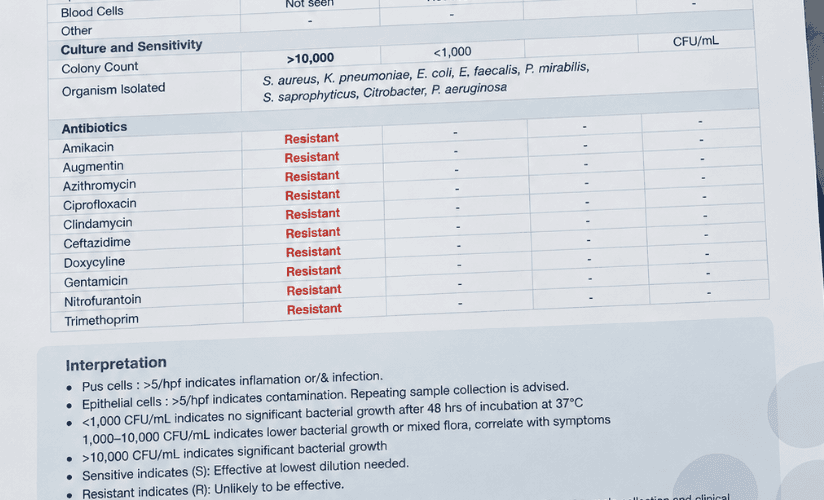
Organisms within MDC’s semen microbiology reporting pathway can include:
The significance of bacterial growth depends on factors including the organism identified, amount of growth, sample quality, symptoms, recent antibiotic use and the wider clinical picture.
What Does the Colony Count Mean?
Culture can also provide information about the amount of bacterial growth, usually expressed as colony-forming units per millilitre (CFU/mL).
The significance of the colony count should be considered alongside the organism identified, symptoms and clinical circumstances.
1,000–10,000 CFU/mL
Lower bacterial growth or mixed flora may require correlation with symptoms, sample quality and the wider clinical context.
>10,000 CFU/mL
Higher bacterial growth may be considered more significant, although organism type and clinical circumstances remain important.
What Is Antibiotic Sensitivity Testing?
Identifying an organism is only part of the microbiological investigation.
Where appropriate, an isolated bacterial organism can also be tested against selected antibiotics. This is known as antibiotic susceptibility or sensitivity testing.
Sensitive
A sensitive result indicates that the organism was susceptible to the antibiotic under the laboratory testing conditions.
Resistant
A resistant result indicates that the organism was not susceptible to that antibiotic under the laboratory testing conditions.
Antibiotic treatment requires clinical assessment. The organism, susceptibility result, symptoms, medical history, allergies, site of infection and previous treatment may all influence the appropriate clinical decision.
Patients should not start, stop or change antibiotics solely because of a laboratory result.
When Might Semen Culture Be Considered?
Semen culture is not required for every man undergoing fertility testing. It answers a specific microbiological question.
Possible Infection or Inflammation
Testing may be considered when symptoms or clinical findings raise concern about infection or inflammation.
Fertility Investigation
A clinician may request microbiology alongside fertility investigations where infection is considered clinically relevant.
Persistent Changes With Symptoms
Persistent changes in semen accompanied by symptoms may justify further assessment rather than judging infection from appearance alone.
Urology or Andrology
A urologist, andrologist, fertility specialist or other clinician may request semen microbiology as part of a wider investigation.
Semen Analysis vs Semen Culture: What’s the Difference?
These investigations answer different questions and should not be treated as interchangeable.
What are the characteristics of the semen and sperm?
- Semen volume
- Sperm concentration
- Motility
- Morphology
- Other semen parameters
Is there microbiological evidence that may require further assessment?
- Microscopic examination
- Bacterial culture
- Organism identification
- Assessment of bacterial growth
- Antibiotic susceptibility where appropriate
Depending on the clinical question, a patient may require semen analysis, semen culture, both investigations, or neither.
Patients primarily concerned about sperm concentration, motility or morphology can explore MDC Semen Analysis .
Does Semen Culture Replace an STI Test?
No. Routine semen culture and sexually transmitted infection testing answer different clinical questions.
A bacterial semen culture should not be assumed to exclude infections requiring specific STI testing methods.
If symptoms, exposure history or clinical assessment suggest a sexually transmitted infection, appropriate sexual health testing may be required separately.
Part of MDC’s Male Fertility Pathway
The purpose of expanding microbiology at MDC is not to perform every available test on every patient.
It gives patients and clinicians another investigation when the clinical question requires it.
MDC’s approach is to select investigations according to the clinical question rather than automatically adding unnecessary tests.
Semen Culture: Quick Answers
Hover over or tap each card for a simple answer.
Frequently Asked Questions
What is a semen culture and sensitivity test?
It is a microbiological investigation of a semen sample. It can include microscopic examination, bacterial culture, identification of organisms and, where appropriate, antibiotic susceptibility testing.
What bacteria can be found in a semen culture?
Depending on the sample, organisms that may be isolated can include E. coli, Klebsiella pneumoniae, Staphylococcus aureus, Enterococcus faecalis, Proteus mirabilis, Staphylococcus saprophyticus, Citrobacter species and Pseudomonas aeruginosa.
What do pus cells in semen mean?
Increased pus cells can be associated with inflammation or infection, but the finding should be interpreted alongside culture results, symptoms and other clinical information.
What does resistant mean on an antibiotic sensitivity report?
Resistant indicates that the isolated organism was not susceptible to that antibiotic under the laboratory testing conditions. Treatment decisions still require clinical assessment.
Can I take antibiotics based on my semen culture result?
Antibiotic treatment should be decided by an appropriately qualified clinician. Patients should not self-prescribe or alter antibiotics solely on the basis of a laboratory report.
Should every fertility patient have a semen culture?
No. Semen culture answers a specific microbiological question and is not automatically required for every fertility investigation.
Should I have a semen analysis as well?
If the clinical question concerns fertility or sperm quality, semen analysis provides information about sperm concentration, motility, morphology and other semen parameters. Semen analysis and semen culture provide different information.
Clinical Interpretation
Semen microbiology findings should be interpreted alongside symptoms, sample quality, organism type, bacterial growth, previous antibiotic exposure and the wider clinical picture.
Antibiotic susceptibility results provide laboratory information to support clinical decision-making. They should not be interpreted as a standalone prescription.
For fertility assessment, semen microbiology should be considered separately from conventional semen analysis and other male fertility investigations.
Semen Culture & Sensitivity Testing in London
Investigate possible bacterial growth with semen microscopy, culture, organism identification and antibiotic susceptibility testing where appropriate at Marylebone Diagnostic Centre.
Marylebone Diagnostic Centre · 73 Baker Street · London W1U 6RD