
Information checked: 24 September 2026
Can tests detect forever chemicals?
Specialist blood tests can measure certain PFAS. Routine blood tests and standard hair mineral analysis cannot. A PFAS result measures specific chemicals in your blood; it does not tell you whether they have caused illness.
Following recent headlines, it is understandable to have questions. Here is what testing can tell you, what it cannot, and when clinical advice may help.
1. What are forever chemicals?
PFAS stands for per- and polyfluoroalkyl substances: a large group of manufactured chemicals used for properties such as resistance to water, oil and heat. They have been used in products including some non-stick coatings, stain-resistant materials, food packaging and firefighting foams.
They are called “forever chemicals” because many persist in the environment. This does not mean every PFAS stays in your body permanently. Different PFAS behave differently, and some remain much longer than others.
2. Can a blood test detect PFAS?
Yes, but it requires a specialist PFAS test. Panels measure a selected group of chemicals, which may include PFOA and PFOS. No standard panel measures every PFAS.
Levels of selected chemicals
A specialist test measures the concentration of the PFAS included in that panel at the time of sampling. Some results can reflect exposure from years earlier.
A diagnosis or a prediction
A result cannot reliably identify where exposure happened, prove that PFAS caused your symptoms, or predict whether you will develop a future health problem.
3. Can hair mineral analysis detect PFAS?
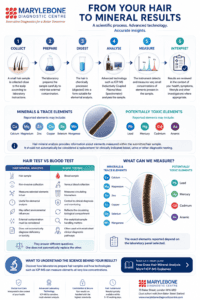
No. Standard hair mineral analysis does not measure PFAS. It measures selected elements in a hair sample. PFAS are organic chemical compounds, rather than minerals or heavy metals, and require different analytical methods.
PFAS have been investigated in hair in research, but this is different from a commercial hair mineral panel. Blood is the established sample used to assess PFAS exposure.
Read about MDC’s hair mineral analysis service to understand its scope. A hair mineral result cannot confirm or exclude PFAS exposure.
4. Should you get tested?
Current UKHSA guidance does not recommend individual PFAS biomonitoring through NHS or private blood tests. It explains that results are generally unlikely to provide clear, useful information for managing an individual’s health and may cause unnecessary worry.
If you have a known workplace exposure, a local contamination concern or symptoms, discuss your circumstances with a clinician. The next step should reflect your exposure history and health, rather than the headline alone.
5. Can routine health checks show PFAS damage?
Routine blood tests cannot identify “PFAS damage”. Cholesterol, liver and kidney tests assess particular health markers. Abnormal results have many possible causes and cannot establish PFAS as the explanation.
Equally, normal results do not rule out PFAS exposure. A clinician may recommend investigations for your symptoms or usual health risks, but these should not be presented as a substitute for measuring PFAS.
Do I need regular monitoring?
Keep up with routine health checks appropriate to your age, medical history and existing conditions. Repeat tests may be useful when a clinician is monitoring a specific concern.
PFAS headlines alone are not a reason for frequent blood panels. The benefit and ideal frequency of repeat PFAS testing are not established.
What about IV therapy?
IV therapy is not an established treatment for PFAS exposure and has not been shown to prevent PFAS-related harm. There is no approved medical treatment to remove PFAS from the body.
If you are considering IV therapy for a separate clinical need, ask about its evidence, risks and alternatives. Contact MDC about its IV services and clinical suitability . PFAS exposure itself is not an indication for an IV drip.
6. What should you do if you are concerned?
- Identify the concern: note any relevant workplace, water-supply or local environmental information.
- Follow local advice: contact your water supplier or public health team about documented contamination concerns.
- Discuss workplace exposure: speak with your employer or occupational health service.
- Seek assessment for symptoms: do not assume that unexplained symptoms are caused by PFAS.
- Avoid unproven detox claims: supplements, IV drips and commercial detox programmes should not be relied upon to remove PFAS or prevent harm.
Quick answers to common questions
Does a normal blood test rule out PFAS exposure?
No. Routine blood tests do not measure PFAS. Normal results cannot confirm that you have no exposure.
Does detecting PFAS mean I am ill?
No. Detectable PFAS indicates exposure to the chemicals measured. It does not, by itself, diagnose illness.
Does hair mineral analysis measure forever chemicals?
No. Standard hair mineral panels measure selected elements, not PFAS.
Can an IV “detox” remove PFAS?
There is no approved medical treatment to remove PFAS from the body. IV drips should not be promoted as PFAS detoxification.
Can a test tell me where exposure happened?
Not reliably. A blood result can reflect exposure from multiple sources over time.
Should everyone book a PFAS blood test?
No. Current UKHSA guidance does not recommend individual PFAS biomonitoring through NHS or private testing. Discuss specific concerns with a clinician.
Make informed choices about your health
Concerned about symptoms or unsure which health checks are appropriate? Contact Marylebone Diagnostic Centre to discuss arranging a clinical consultation.
Any investigations or follow-up should be based on your individual health needs. Routine blood profiles and hair mineral analysis do not measure PFAS.
Marylebone Diagnostic Centre
73 Baker Street, London W1U 6RD