Understanding Your Semen Analysis Results – What the Numbers Really Mean in London
Reviewed by Dr Lauren Holland • Marylebone Diagnostic Centre
Results within 24 – 42 hours • Central London • Private & discreet testing
Who This Is For
This guide is for men who have received a semen analysis report and feel unsure what the results actually mean.
If you are seeing numbers marked in red, or words like low motility, borderline morphology, or immotile sperm, this article will help you understand what matters and what to do next.
At Marylebone Diagnostic Centre, we use research-led diagnostics and a data-driven health approach.
Our goal is not to alarm you, but to explain your results clearly and guide you with evidence-based fertility care.
Why Semen Analysis Needs Proper Interpretation
A semen analysis is not a pass-or-fail test.
It is a snapshot of sperm health, based on data.
Numbers only become useful when they are interpreted correctly.
Clinically, we often see:
- Men with strong sperm counts but low movement
- Men with normal volume but high immotile sperm
- Men with borderline morphology who panic unnecessarily
This is why MDC focuses on patterns, not isolated values.
The Main Sections of a Semen Report
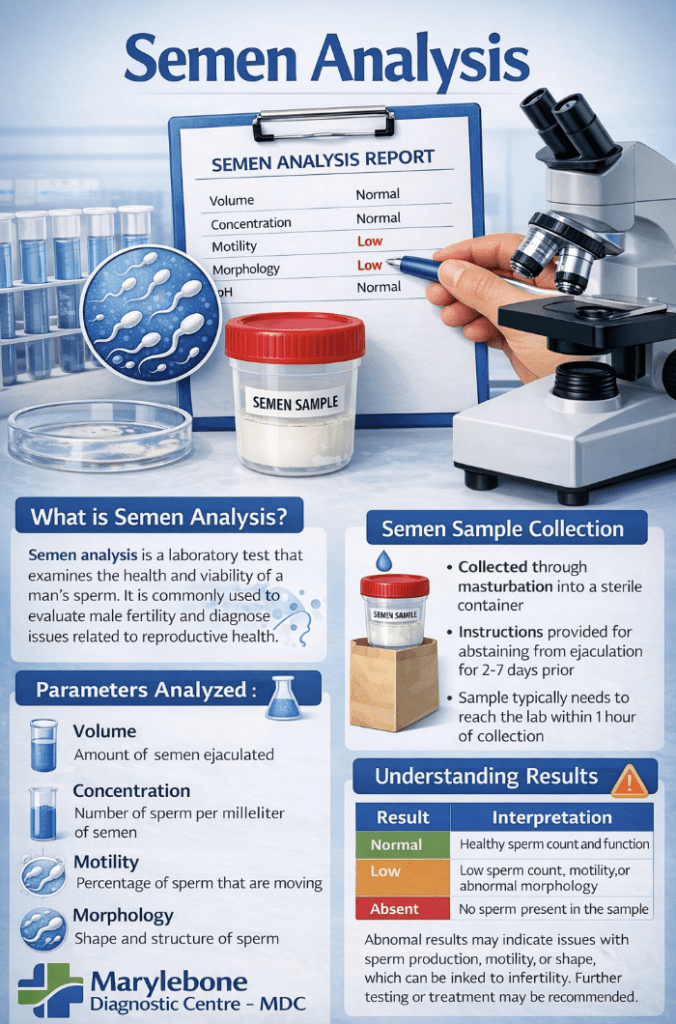
Most semen analysis reports include:
- Sample quality
- Sperm count
- Motility (movement)
- Morphology (shape)
- Advanced motion parameters (CASA data)
Let’s break these down.
1. Sample Quality – What It Tells Us
Key markers include:
- Liquefaction – should be normal
- Viscosity – affects sperm movement
- pH – usually between 7.2 and 8.0
If these are normal, it tells us the environment is suitable for sperm survival.
This is a strong foundation.
2. Sperm Count – Quantity Is Not the Whole Story
Typical reference points:
- Concentration: ≥ 16 million/ml
- Total sperm number: ≥ 39 million
Many patients are relieved when they see high numbers here.
But fertility is not just about how many sperm you have.
It is about how well they move and function.
3. Motility – One of the Most Important Numbers
Motility measures how sperm move.
There are three main types:
- Progressive – swimming forward
- Non-progressive – moving but not forward
- Immotile – not moving
What patients often see
Some reports show:
- Total motility below normal range
- Progressive motility well below ideal
- High immotile percentage
This means sperm are present, but many are not moving effectively.
Clinically, this can affect:
- Natural conception
- Timing success
- Assisted fertility outcomes
But it does not mean fertility is impossible.
It means this is where data-driven health decisions matter most.
4. Morphology – The Most Misunderstood Result
Morphology looks at sperm shape.
Normal reference:
- 4% or more normal forms
Many men are shocked when they see low percentages.
In reality, even fertile men rarely have high morphology scores.
What matters is not just the number, but:
- How this result fits with motility
- Whether there are repeat patterns
- Whether DNA quality is also affected
This is why MDC often pairs morphology findings with DNA fragmentation testing.
5. Advanced Motion Data – What CASA Shows
Some MDC reports include computer-assisted sperm analysis (CASA).
These values include:
- VAP – average path velocity
- VSL – straight-line speed
- VCL – curvilinear speed
- STR / LIN – how straight sperm swim
- ALH – head movement amplitude
- BCF – beat frequency
When these numbers are low, sperm often:
- Move slowly
- Drift instead of swim
- Struggle to reach the egg
This explains why some men have high counts but reduced fertility success.
This is exactly where research-led diagnostics adds value.
What a Result Like This Usually Means
When we see a pattern of:
- Good volume
- Strong count
- Low motility
- High immotile percentage
- Borderline morphology
It often points to functional sperm issues, not production issues.
Common contributing factors include:
- Oxidative stress
- Recent illness or fever
- Smoking or alcohol
- Poor sleep
- High stress
- Nutrient deficiency
- Hormonal imbalance
These are modifiable factors in many men.
Why One Semen Test Is Not the Final Answer
Sperm production follows a three-month cycle.
Today’s result reflects your health from 10–12 weeks ago.
This is why MDC often recommends:
- Repeat semen analysis
- DNA fragmentation testing
- Hormone profiling
- Lifestyle review
This is evidence-based longevity for fertility, not guesswork.
When Semen Analysis Alone Is Not Enough
If motility or morphology are low, MDC may recommend:
Add-on tests
- DNA Fragmentation Test – checks sperm genetic integrity
- Male Hormone Profile – testosterone, SHBG, FSH, LH, prolactin
- Oxidative stress assessment (via markers and clinical pattern)
These help us move from numbers to actionable insight.
Mid-Page Call to Action
If you already have a semen report and want proper interpretation:
Book a Semen Analysis Review at Marylebone Diagnostic Centre
Private • Central London • Results in 24–42 hours
How MDC Interprets Results Differently
Many clinics give you numbers.
Few explain what they really mean.
At MDC, we work on:
- Research-led diagnostics – guided by evidence
- Data-driven health – trends, not snapshots
- Evidence-based longevity – protecting fertility long term
We look at:
- Patterns over time
- Lifestyle impact
- Hormonal balance
- DNA quality
- Metabolic health
This creates a plan, not just a report.
Local Trust Signals
Patients choose MDC because we offer:
- Central London location – 73 Baker Street
- Results in 24 – 42 hours
- QC-validated laboratory accuracy
- Clinician-reviewed reports
- Fully private and discreet care
- Open Monday–Saturday
- 5-minute walk from Baker Street Tube
- Westminster residents receive 20% off
What You Should Do Next – Book Your Test
If your semen analysis shows:
- Low motility
- High immotile sperm
- Borderline morphology
- Or results you do not understand
Your next step should not be panic.
It should be clarity.
Most men benefit from starting with:
- Repeat semen analysis
- DNA fragmentation testing
- Male hormone profile
This is how data-driven fertility care begins.
Book Your Semen Analysis at Marylebone Diagnostic Centre
Marylebone Diagnostic Centre
73 Baker Street, London W1U 6RD
+44 7495 970109 – available on WhatsApp
Monday–Saturday, 08:00–16:00
Fast. Private. Clinically trusted.
Research-led diagnostics. Data-driven health. Evidence-based longevity.