
What Does a High Sperm DNA Fragmentation Result Actually Mean?


- What Is Sperm DNA Fragmentation?
- What Does a "High DFI" Mean?
- Does High DNA Fragmentation Mean I Am Infertile?
- Can You Have High DNA Fragmentation With a Normal Semen Analysis?
- What Can Cause High Sperm DNA Fragmentation?
- Can High DNA Fragmentation Cause Miscarriage?
- Can You Still Get Pregnant Naturally With High DNA Fragmentation?
- Does High DNA Fragmentation Mean IVF or ICSI Will Fail?
- My DNA Fragmentation Is High. What Should I Do Next?
- Can High Sperm DNA Fragmentation Improve?
- Should I Repeat My DNA Fragmentation Test?
- What This Result Does and Does Not Tell You
- DNA Fragmentation Testing at Marylebone Diagnostic Centre
- Frequently Asked Questions
You have received your sperm DNA fragmentation result.
It says your DNA fragmentation is high, elevated, or above the laboratory's expected range.
Naturally, the first questions are often:
Does this mean I am infertile? Can we still get pregnant naturally? Could this explain a miscarriage or unsuccessful IVF? Can sperm DNA fragmentation improve?
The most important thing to understand is this:
An elevated result is therefore a finding to investigate, not a fertility verdict.
What Is Sperm DNA Fragmentation?
Each sperm cell carries genetic material that may ultimately contribute half of an embryo's DNA.
That genetic material is tightly packaged inside the sperm head.
Sperm DNA fragmentation (SDF) refers to breaks or damage affecting this DNA.
Some degree of DNA damage can occur within sperm. The clinical question is whether the amount detected by the particular laboratory method is elevated and whether it is relevant to the couple's fertility history.
This is different from the information provided by a conventional semen analysis.
A semen analysis primarily examines characteristics such as sperm concentration, total sperm number, progressive motility, total motility, morphology, semen volume and other laboratory characteristics.
DNA fragmentation testing examines something different: the integrity of the genetic material carried inside the sperm.
That is why a man can potentially have a relatively reassuring semen analysis while still having elevated sperm DNA fragmentation.
What Does a "High DFI" Mean?
You may see the abbreviation DFI, or DNA Fragmentation Index, on your report.
In simple terms, it describes the proportion of sperm showing DNA fragmentation according to the testing method used.
Generally, how this number is reported and thresholded varies by laboratory and assay.
But there is an important scientific point that is often lost online:
There is no single percentage that should be applied universally to every DNA fragmentation test.
Different laboratory techniques measure sperm DNA damage differently.
Methods can include assays such as:
- Sperm Chromatin Structure Assay (SCSA)
- Sperm Chromatin Dispersion (SCD)
- TUNEL
- Comet assay
The numerical result therefore needs to be interpreted using the reference ranges and methodology of the laboratory that performed your test, alongside your clinical circumstances.
This is why searching online for "Is 20% DNA fragmentation bad?" or "Can I conceive with 30% DFI?" can sometimes create more confusion than clarity.
Your number matters. But the method, laboratory reference range and clinical context matter too.
Does High DNA Fragmentation Mean I Am Infertile?
No.
This is probably the most important reassurance in this article.
A high sperm DNA fragmentation result is not equivalent to a diagnosis of infertility.
Male fertility cannot be reduced to one laboratory number.
Pregnancy depends on numerous interacting factors involving sperm, egg, embryo, female reproductive health, age, timing and underlying medical factors.
An elevated DNA fragmentation result may represent an additional male-factor risk, but it does not mean conception cannot occur.
Likewise, a low DNA fragmentation result cannot guarantee pregnancy.
Think of DNA fragmentation as one piece of the fertility picture rather than the entire picture.
Can You Have High DNA Fragmentation With a Normal Semen Analysis?
Yes. And this is exactly why DNA fragmentation testing exists as an additional investigation.
Imagine a semen analysis showing good sperm concentration, good progressive motility and acceptable morphology.
Those are reassuring findings.
But conventional semen analysis does not directly examine DNA integrity.
A sperm cell can therefore appear acceptable by conventional parameters while carrying DNA damage that is not visible through routine assessment.
Current AUA/ASRM male-infertility guidance specifically notes that even with a "normal" semen analysis, sperm may still have high DNA fragmentation in certain clinical situations, particularly following failed assisted-reproduction cycles or recurrent pregnancy loss.
This does not mean everyone with a normal semen analysis needs DNA fragmentation testing.
In fact, major guidelines do not recommend sperm DNA fragmentation testing as part of every couple's initial fertility assessment.
The value of the test depends on the question being investigated.
What Can Cause High Sperm DNA Fragmentation?
There isn't always one identifiable cause.
However, several biological, medical, lifestyle and environmental factors have been associated with increased sperm DNA damage.
Oxidative Stress
Oxidative stress is one of the major mechanisms associated with sperm DNA damage. Reactive oxygen species are naturally present within the reproductive system. The problem occurs when the balance between oxidants and the body's antioxidant defences becomes disrupted. Excessive oxidative stress can damage sperm membranes and DNA.
Varicocele
A varicocele is an enlargement of veins around the testicle. In some men, clinically significant varicocele can adversely affect testicular function and sperm quality and has been associated with increased oxidative stress and sperm DNA fragmentation. If a varicocele is suspected, this is a reason for proper medical/urological assessment, not simply repeated laboratory testing.
Smoking
Smoking has been associated with poorer sperm health and increased oxidative stress. For a man with elevated DNA fragmentation who smokes, smoking exposure is therefore an important part of the clinical history.
Recent Fever or Significant Illness
Sperm production is sensitive to temperature and systemic illness. A significant fever or illness in the preceding months may temporarily influence semen parameters and sperm DNA integrity. This is why MDC asks about recent illness as part of its pre-semen-analysis assessment.
Heat Exposure
Repeated or substantial testicular heat exposure may adversely affect sperm production. This can be relevant when reviewing occupational exposure, frequent sauna/hot-tub use or other significant sources of heat.
Increasing Paternal Age
Sperm biology changes with age, and increasing paternal age has been associated with increased sperm DNA damage in some studies. Age should therefore be considered as one factor within the overall assessment rather than used as a standalone explanation.
Infection or Inflammation
Certain infections and inflammatory processes within the male reproductive tract may adversely affect sperm quality. However, an elevated DNA fragmentation result does not automatically mean that an infection is present. Infection testing should be based on symptoms, semen findings, clinical history and medical assessment.
Metabolic and Lifestyle Factors
Obesity, metabolic health, environmental exposures, diet and other lifestyle factors may also influence oxidative stress and reproductive health. Again, the objective is not to blame the patient for an abnormal result. The objective is to identify potentially relevant and modifiable factors.
Can High DNA Fragmentation Cause Miscarriage?
This requires careful wording.
Research has identified an association between elevated sperm DNA fragmentation and pregnancy loss, and male-factor evaluation is increasingly recognised as relevant in recurrent pregnancy loss.
Current AUA/ASRM guidance recommends male evaluation in couples experiencing recurrent pregnancy loss and includes sperm DNA fragmentation among the investigations to consider.
However, a high DNA fragmentation result cannot prove that sperm DNA damage caused an individual miscarriage.
Pregnancy loss has many possible causes. These can involve embryonic chromosomal abnormalities, maternal age, uterine factors, endocrine factors, genetic factors, male reproductive factors and other medical causes.
For that reason, recurrent pregnancy loss should be investigated as a couple-level problem, rather than assuming either partner is responsible.
Can You Still Get Pregnant Naturally With High DNA Fragmentation?
Yes, pregnancy can still occur.
An elevated DNA fragmentation result does not create a biological switch where pregnancy becomes impossible.
Instead, it may be associated with a reduced probability of favourable reproductive outcomes in some populations.
Individual outcomes vary considerably.
This is why MDC should never tell a patient "Your DFI is high, therefore you need IVF," nor should we say "Your DFI is low, therefore you will conceive naturally."
Neither statement is scientifically justified.
The result should help inform the next clinical decision, not dictate it on its own.
Does High DNA Fragmentation Mean IVF or ICSI Will Fail?
No.
An elevated result does not mean IVF or ICSI cannot succeed.
Research has examined associations between sperm DNA fragmentation and assisted-reproduction outcomes, but results vary according to patient population, laboratory method, fertility treatment and other factors.
Current male-infertility guidance recognises sperm DNA fragmentation as something that may be considered particularly after failed assisted reproductive technology cycles, rather than recommending it routinely for every couple at the beginning of fertility investigation.
That distinction is important.
Does ICSI Fix DNA Fragmentation?
Not exactly.
ICSI involves an embryologist selecting a sperm and injecting it directly into an egg.
This can overcome several barriers to fertilisation.
However, selecting a sperm based on visible characteristics does not necessarily provide complete information about the DNA contained within it.
Therefore, ICSI should not be assumed to eliminate DNA-fragmentation-related concerns simply because it bypasses natural sperm selection.
At the same time, an elevated DNA fragmentation result does not automatically determine which assisted-reproduction technique should be used.
That decision belongs with the fertility team managing the couple.
My DNA Fragmentation Is High. What Should I Do Next?
This is where the test becomes clinically useful.
Don't immediately buy supplements. Don't assume IVF is your only option. And don't simply repeat the same test next week.
Instead, ask:
1. What did my semen analysis show?
Look at the DNA fragmentation result alongside concentration, total sperm number, motility, morphology, volume and other semen findings.
MDC has a separate guide explaining how to interpret conventional semen-analysis results.
2. Was I recently ill?
Think about the preceding weeks and months. Significant fever or systemic illness may be relevant.
3. Are there obvious lifestyle or environmental factors?
Consider smoking, significant heat exposure, occupational exposures and general metabolic health.
The goal isn't to create an enormous list of restrictions. It is to identify genuinely relevant factors.
4. Could there be a varicocele?
If there is a known or suspected varicocele, specialist examination may be appropriate.
5. Should my hormones be checked?
Depending on the wider fertility picture, reproductive hormone testing may include FSH, LH, Testosterone, SHBG and Prolactin.
Hormonal testing doesn't measure DNA fragmentation, but it can help investigate other aspects of male reproductive function.
6. Is infection investigation appropriate?
This depends on symptoms and semen findings. Testing everyone for every possible infection simply because DNA fragmentation is high is not good diagnostics.
7. What is happening on the couple's side?
Male fertility should never be investigated in isolation from the couple's fertility history. Age, ovarian reserve, ovulation, tubal factors, previous pregnancies and fertility-treatment history may substantially alter what should happen next.
Can High Sperm DNA Fragmentation Improve?
Potentially, depending on the underlying cause.
This is another area where online fertility content often becomes too simplistic.
You may encounter claims such as "Take these antioxidants for three months and your DNA fragmentation will fall."
Biology is not that predictable.
Where a relevant modifiable factor exists, addressing that factor may potentially improve sperm health.
Examples could include stopping smoking, addressing clinically relevant varicocele, recovering after significant illness, reducing relevant heat exposure, improving metabolic health, or managing an identified medical problem.
But the appropriate intervention depends on the cause.
What About Antioxidants?
Oxidative stress is biologically relevant to sperm DNA damage, which is why antioxidant supplements are frequently marketed to men with high DFI.
However, "antioxidant" does not automatically mean "effective fertility treatment."
Different supplements, doses and patient populations have produced varying results in research.
More is not necessarily better.
Patients should therefore be cautious about taking multiple high-dose supplements without understanding what they contain or whether there is a clinical reason for them.
At MDC, the more sensible approach is identifying and addressing genuinely relevant modifiable factors under medical guidance, rather than starting broad, unsupervised high-dose supplementation.
How Long Does Sperm DNA Take to Improve?
Changes in sperm health do not happen overnight.
Sperm production and maturation take place over a period of weeks, so an intervention today would not be expected to completely change the sperm population tomorrow.
This is why fertility reassessment is generally considered over an appropriate interval rather than after a few days.
MDC's current male-fertility guidance commonly uses approximately three months as a practical reassessment interval when lifestyle factors or treatment have changed, reflecting the biology of sperm production.
The exact timing should depend on the clinical circumstances.
Should I Repeat My DNA Fragmentation Test?
Sometimes. But there should be a reason.
Repeat testing may be useful after addressing an identified risk factor, following recovery from significant illness, after treatment recommended by a doctor, before a fertility-treatment decision where the updated result may alter management, or when advised by an andrologist, urologist or fertility specialist.
The most useful question before repeating the test is, "What decision will this new result help us make?"
If the answer is unclear, simply repeating the number may not add much value.
What If My Semen Analysis Is Normal but DNA Fragmentation Is High?
This deserves its own section because it can be confusing.
It does not mean your semen analysis was wrong. The two tests measure different things.
Your semen analysis may genuinely show reassuring count, motility and morphology, while DNA fragmentation testing identifies a different characteristic of sperm quality.
This pattern may be particularly relevant where there is otherwise unexplained infertility, recurrent pregnancy loss or unsuccessful fertility treatment.
For a deeper explanation, see My Semen Analysis Is Normal, Could I Still Have a Fertility Problem?
What If Both My Semen Analysis and DNA Fragmentation Are Abnormal?
This can provide a stronger reason for a comprehensive male-factor assessment.
Depending on the particular abnormalities, further investigation might involve repeat semen analysis, male reproductive hormones, clinical examination, varicocele assessment, infection investigation where indicated, or andrology/urology review.
The important principle remains the same: treat the patient and the fertility history, not one laboratory number.
What This Result Does and Does Not Tell You
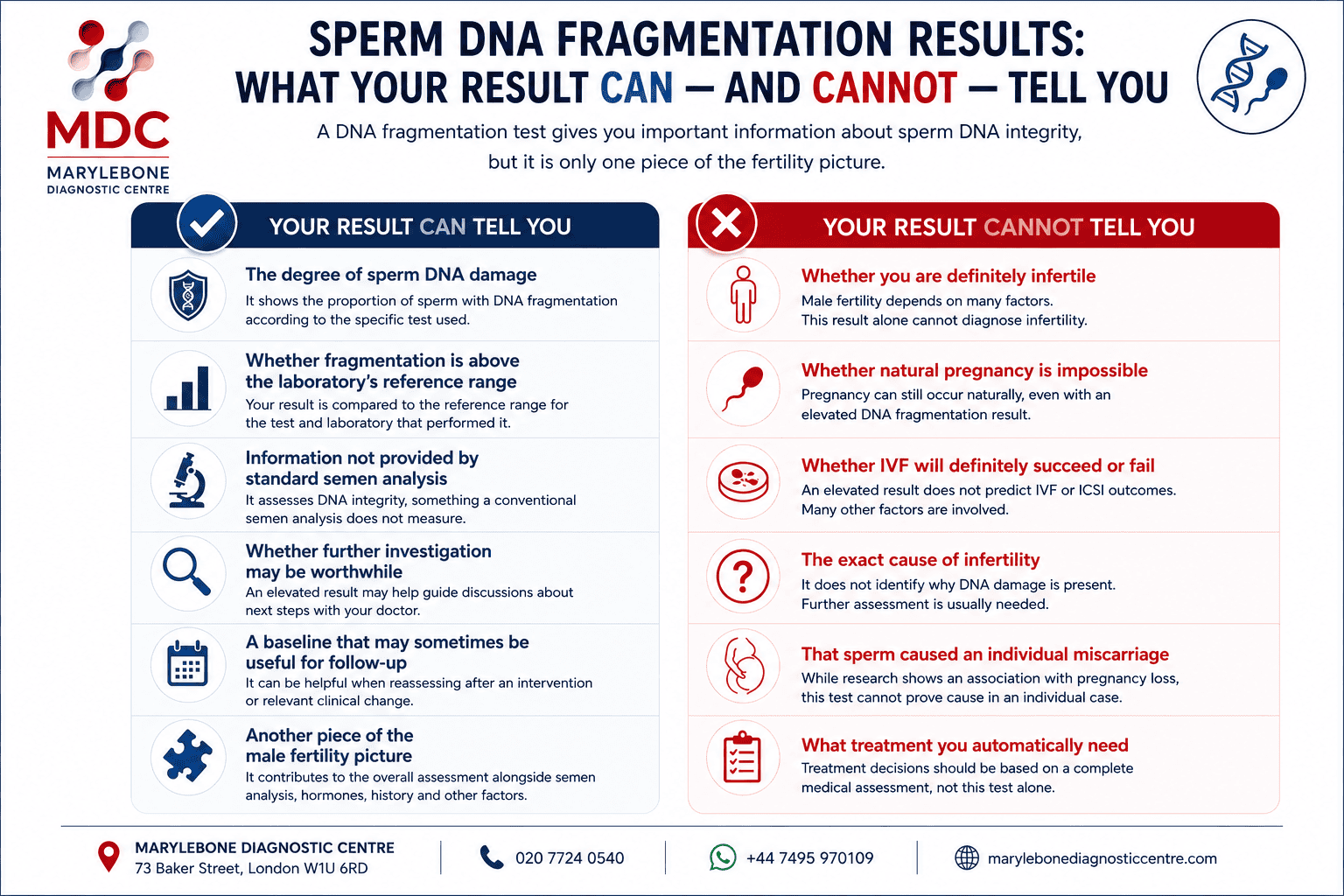
WHAT THIS RESULT DOES TELL YOU
- The proportion of sperm showing DNA damage, according to the specific assay used
- An additional male-factor risk marker worth investigating
- A reason to review your semen analysis, lifestyle and medical history together
WHAT THIS RESULT DOES NOT TELL YOU
- That you are infertile
- That natural conception is impossible
- That IVF or ICSI will fail
- The definite cause of a past miscarriage
- Which treatment you should have, on its own
DNA Fragmentation Testing at Marylebone Diagnostic Centre
Marylebone Diagnostic Centre provides advanced male-fertility diagnostics from 73 Baker Street, Central London.
MDC currently provides:
Comprehensive Semen Analysis
Measures concentration, motility, morphology and other conventional semen parameters.
Sperm DNA Fragmentation Testing
Assesses sperm DNA integrity beyond conventional semen analysis.
Male Fertility Hormone Testing
Provides additional information about hormonal factors involved in male reproductive function.
Comprehensive Male Fertility Profiles
For patients requiring a broader investigation combining conventional semen assessment, DNA fragmentation and hormonal testing.
MDC currently lists its standalone DNA Fragmentation Test at £399, using a semen sample, with a stated 24-hour turnaround time.
Importantly, MDC is a diagnostic centre rather than an IVF clinic. The purpose of testing is to generate clinically useful information that patients can take into discussions with their doctor, andrologist, urologist or fertility specialist.
73 Baker Street
London W1U 6RD
Central London, near Baker Street Station
Frequently Asked Questions
What percentage of sperm DNA fragmentation is considered high?
There is no single cut-off that should be applied to every sperm DNA fragmentation assay. Interpretation depends on the testing method, laboratory reference ranges and clinical context. Use the reference information supplied with your specific laboratory report rather than comparing your result blindly with percentages found online.
Is 20% DNA fragmentation high?
It depends on the assay and laboratory reference range. A percentage cannot be interpreted reliably without knowing how the sample was tested.
Is 30% DNA fragmentation very high?
Again, interpretation is method-dependent. Some assays and laboratories may classify results around this level as elevated, but the appropriate interpretation should come from the reference range associated with your test.
Does high DNA fragmentation mean infertility?
No. It represents increased sperm DNA damage according to the assay used. It does not mean pregnancy is impossible.
Can I conceive naturally with high DNA fragmentation?
Yes. Natural conception can still occur. An elevated result represents a potential fertility risk factor rather than an absolute barrier to pregnancy.
Can high sperm DNA fragmentation cause miscarriage?
Elevated sperm DNA fragmentation has been associated with pregnancy loss in research, and current male-infertility guidance recognises DNA fragmentation testing in the evaluation of recurrent pregnancy loss. It cannot, however, prove the cause of an individual miscarriage.
Can sperm DNA fragmentation improve?
Potentially. This depends on the underlying cause and whether relevant factors can be modified or treated.
How can I reduce sperm DNA fragmentation?
There is no single treatment for every man. The appropriate approach depends on factors such as smoking, significant heat exposure, recent illness, varicocele, metabolic health and other clinical findings. Medical assessment may be appropriate.
Should I take antioxidants for high DNA fragmentation?
Not automatically. Oxidative stress is associated with sperm DNA damage, but supplement evidence is not sufficiently simple to assume that every patient with an elevated result should take the same antioxidant regimen.
Should I repeat the test after three months?
A repeat test may be appropriate after an intervention or relevant clinical change, but it should have a clear purpose. Approximately three months is commonly used when reassessing sperm-related changes, but timing should be individualised.
Can high DNA fragmentation occur with good morphology?
Yes. Morphology and DNA integrity assess different characteristics of sperm.
Can high DNA fragmentation occur with good motility?
Yes. Motility describes movement; it does not directly measure DNA integrity.
Does ICSI bypass high DNA fragmentation?
ICSI can overcome some barriers to fertilisation but does not itself repair damaged sperm DNA. Treatment decisions should be made by the fertility team based on the complete clinical picture.
Should my partner also be tested?
Infertility and recurrent pregnancy loss should generally be approached as couple-level clinical problems. The appropriate investigations for each partner depend on their medical and reproductive history.
What should I do after receiving a high DFI result?
Start by reviewing the result alongside your semen analysis, medical history and fertility history. Depending on the circumstances, further evaluation may include reproductive hormones, assessment for varicocele or other male-factor issues, investigation of infection when indicated, and specialist andrology/urology or fertility review.
The Bottom Line
A high sperm DNA fragmentation result deserves attention. It does not deserve panic.
It does not mean "I am infertile." It does not mean "We cannot conceive naturally." It does not mean "IVF will fail." And it certainly does not tell you "This is definitely why we miscarried."
What it tells you is that a higher proportion of the sperm assessed showed DNA damage according to the laboratory method used. Now we need to understand that result within the rest of your fertility picture.
That means looking at your conventional semen analysis, fertility history, recent illness, lifestyle and medical factors and deciding whether further investigation is justified.
A laboratory number becomes valuable only when it helps answer the next question.
At Marylebone Diagnostic Centre, that is how we believe male fertility testing should work: measure accurately, interpret carefully, investigate intelligently.
Male Fertility Testing in Central London
Explore related resources: Male Fertility Testing at MDC, Understanding Your Semen Analysis Results.

