
What Is the IVF Success Rate? Understanding Your Chances Before Treatment
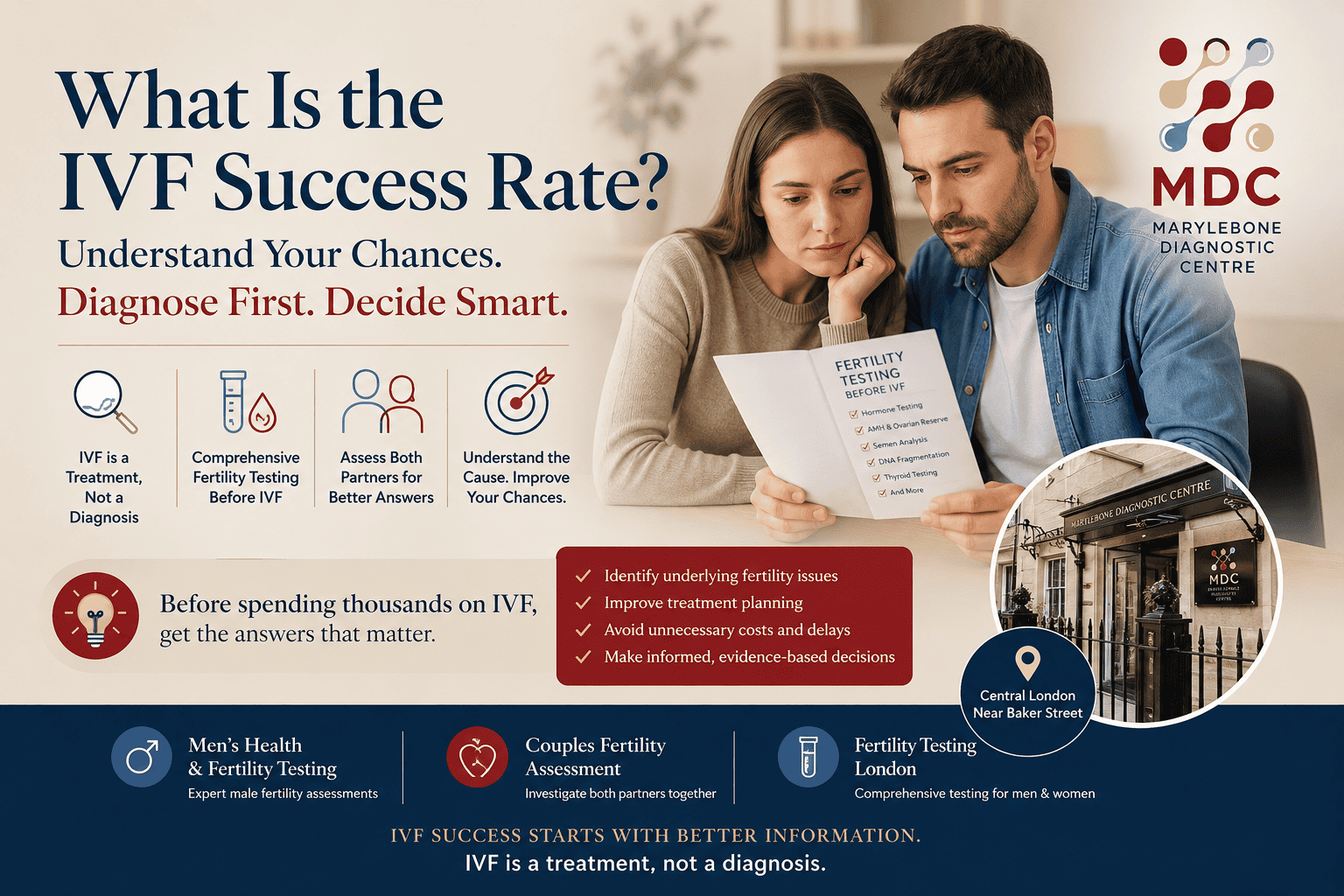
The average IVF success rate in the UK is approximately 24% live birth rate per embryo transferred across all ages, rising to around 32% for women under 35. However, these national figures only tell part of the story. Before committing to fertility treatment costing thousands of pounds, understanding the underlying cause of infertility can significantly improve treatment planning and outcomes. IVF is a treatment, not a diagnosis - and the most informed patients are those who investigate why they are struggling to conceive before deciding how to treat it.
This guide explains IVF success rates by age, what causes IVF cycles to fail, and why comprehensive fertility testing - for both partners - should ideally come before any major treatment decision.
- Should you spend thousands on IVF before understanding the cause?
- What is the IVF success rate?
- IVF success rates by age
- Fresh vs frozen embryo transfers
- What causes IVF to fail?
- Why success rates don't tell the whole story
- What tests should you have before IVF?
- Male fertility and IVF success
- Can some couples avoid IVF through earlier diagnosis?
- Questions to ask before spending money on IVF
- Key takeaways
- Frequently asked questions
Should You Spend Thousands on IVF Before Understanding the Cause of Infertility?
Many couples begin researching IVF success rates before fully understanding why they have been unable to conceive naturally.
While IVF can be highly effective, it is important to remember that IVF is a treatment rather than a diagnosis. Before committing to fertility treatment that may cost several thousand pounds per cycle, many fertility specialists recommend a comprehensive assessment of both partners.
Investigations may identify:
- Male factor infertility
- Hormonal imbalances
- Reduced ovarian reserve
- Ovulation disorders
- Thyroid dysfunction
- Sperm DNA fragmentation
- Lifestyle factors affecting fertility
Understanding these factors can help patients make more informed decisions and ensure the most appropriate treatment pathway is chosen.
At Marylebone Diagnostic Centre, patients can explore comprehensive fertility investigations before making major treatment decisions.
Many couples are surprised to discover that a detailed fertility assessment may uncover factors that influence treatment outcomes before IVF even begins. Understanding the cause of infertility first allows patients to make informed, evidence-based decisions rather than relying solely on average success rate statistics.
What Is the IVF Success Rate?
The current UK IVF success rate is approximately 24% live birth rate per embryo transferred, based on recent data from the Human Fertilisation and Embryology Authority (HFEA). For women under 35 using their own eggs, this figure rises to roughly 32%. Success varies significantly depending on patient age, embryo quality, sperm quality, and underlying fertility diagnoses.
The standard measure of IVF success in the UK is the live birth rate per embryo transferred - meaning the proportion of embryos transferred that result in at least one healthy baby born alive. The HFEA collects and publishes data from every licensed fertility clinic in the country, making it the most authoritative source for UK IVF statistics.
It is important to understand that average success rates represent population-level data. Your individual circumstances - including your age, medical history, ovarian reserve, the quality of both eggs and sperm, and any underlying conditions - will determine your personal likelihood of a successful pregnancy far more than any national average.
Successful IVF outcomes are often measured by live birth rates per cycle initiated, but many clinics also report clinical pregnancy rates, which tend to be higher because they include pregnancies that may not progress to a live birth. When comparing clinics, always check which measure is being used.
IVF Success Rates by Age
A woman's age remains the single most important factor affecting IVF success rates. Recent data from HFEA-derived UK statistics shows a clear decline in live birth rates as maternal age increases.
| Age Group | Live Birth Rate Per Embryo Transferred | Cumulative Live Birth Rate (3 Complete Cycles) |
|---|---|---|
| Under 35 | ~32% | ~65–68% |
| 35–37 | ~25% | ~54–58% |
| 38–39 | ~15% | ~39–42% |
| 40–42 | ~9% | ~24–27% |
| 43–44 | ~3% | ~8–10% |
| Over 44 | ~2% | ~5–7% |
IVF success rates vary significantly based on maternal age. Women under 35 have a 55% live birth rate per cycle in many well-performing clinics, while live birth rates drop significantly after age 40. Women over 42 have the lowest IVF success rates with their own eggs, and donor eggs may offer significantly higher success rates for this group.
Success rates decrease as women age, especially over 35, because older maternal age leads to diminished egg quality and quantity. Eggs from older women are more likely to carry chromosomal abnormalities, which affects embryo quality, implantation, and miscarriage rates. Miscarriage rates for IVF also increase with maternal age.
The average age of women undergoing ART (assisted reproductive technology) is 36.4 years - a point at which the decline in fertility is already well underway.
Fresh vs Frozen Embryo Transfers by Age
Frozen embryo transfers generally have higher success rates than fresh transfers. Fresh transfers can be affected by elevated oestrogen levels from ovarian stimulation, while frozen transfers allow the body to return to natural hormonal balance before embryo transfer. A study included 720 women comparing fresh and frozen transfers, supporting this finding.
For women under 37, some UK clinics report frozen embryo transfer live birth rates of 36–40% per embryo transferred, compared with slightly lower rates for fresh embryo transfers. For older patients, the difference narrows, though vitrification techniques have improved frozen transfer outcomes across all age groups.
Realistic Expectations by Age Group
What Causes IVF to Fail?
IVF can fail due to poor embryo quality, chromosomal abnormalities, implantation problems, uterine conditions, undiagnosed hormonal imbalances, or male fertility factors including sperm DNA fragmentation. Many failures result from issues that could have been identified through comprehensive fertility testing before treatment began.
Embryo Quality and Chromosomal Abnormalities
Higher-quality embryos have better implantation success rates. Embryos are graded from A to F based on quality, and embryos that reach the blastocyst stage have higher chances of implantation. However, embryo quality cannot be predicted before transfer day - it is only fully assessed at the point of transfer or biopsy.
As women age, a greater proportion of eggs carry chromosomal errors (aneuploidy), leading to failed fertilisation, failed development, implantation failure, or early miscarriage. Genetic testing can improve embryo selection and increase implantation rates. PGT-A testing improves embryo selection for IVF by identifying chromosomally normal embryos before transfer.
Implantation Failure and Uterine Factors
Even a genetically normal embryo needs a receptive uterine environment. Uterine conditions can hinder embryo implantation - including endometriosis, thin endometrium, fibroids, polyps, scarring, or hormonal dysregulation affecting the uterine lining. These conditions are often identifiable through ultrasound or other investigations before IVF begins.
Recurrent implantation failure - typically defined as three or more failed transfers - is often associated with combined male and female factors, fewer high-quality embryos, and low fertilisation rates.
Male Fertility Factors
IVF success is dependent on both egg and sperm quality. Yet male fertility is frequently overlooked in IVF planning. A UK study of 203 IVF couples measured sperm DNA fragmentation using the Comet assay and found that live births dropped from approximately 33% when DNA fragmentation was below 25% to just 13% when fragmentation exceeded 50%.
Standard semen analysis parameters - count, motility, and morphology - may appear normal while underlying sperm DNA damage silently reduces the chances of success. This is why sperm DNA testing is increasingly recognised as essential before IVF.
Undiagnosed or Combined Infertility
"Unexplained infertility" often masks subtle problems in both partners. Duration of infertility is itself predictive - couples who have been trying for longer tend to have lower IVF success rates. Previous pregnancy history can raise success rates for subsequent IVF cycles, while low ovarian reserve, poor egg retrieval, and inability to freeze embryos are associated with reduced cumulative outcomes.
Why IVF Success Rates Do Not Tell the Whole Story
Understanding IVF success rates requires knowing what the numbers actually measure, how clinics report them, and why population-level statistics may not reflect your individual chances. IVF is a treatment, not a diagnosis - and success rate data without proper context can be misleading.
Different Measures, Different Numbers
IVF success rates can be reported per embryo transferred, per embryo transfer procedure, per cycle started, or per egg collection. These denominators are not interchangeable. "Live birth per embryo transferred" tends to produce the highest-looking figures, while "per cycle started" is more conservative because it includes cycles that are cancelled or that fail to produce viable embryos.
HFEA data reports live birth rates per embryo transferred. When comparing clinics, ensure you are comparing like with like.
Clinic Case Mix Matters
A fertility clinic treating a higher proportion of older patients or those with complex infertility diagnoses will often report lower overall success rates - even if the quality of care is excellent. Conversely, a clinic that is selective about which patients it accepts may show higher success rates without necessarily being a better clinic. Always ask for success rate data in your exact age group and with your specific circumstances.
Cumulative Success vs One Cycle
Many fertility patients assume that one cycle of IVF either works or doesn't. In reality, cumulative success improves substantially over multiple IVF cycles. A UK population-based study of 178,898 women found that after three complete cycles, the cumulative live birth rate was approximately 42.3% across all ages. Over eight complete cycles in ideal conditions, the chance may rise to 80% or more.
For example, a 30-year-old woman with two years of unexplained infertility has approximately a 46% chance of a live birth from her first complete cycle - rising to around 79% over three complete cycles. If fewer eggs are retrieved, or no embryos are suitable for freezing, these figures drop considerably.
The quality of laboratory facilities influences IVF treatment outcomes, and factors such as whether a clinic performs blastocyst culture, vitrification, or single embryo transfer all affect how success rate data should be interpreted.
What Tests Should You Have Before IVF?
Before starting IVF treatment, many fertility specialists recommend a comprehensive fertility assessment for both partners. Understanding the underlying cause of infertility can help guide treatment decisions, identify factors that may affect IVF outcomes, and ensure patients are pursuing the most appropriate pathway.
Recommended Tests Before IVF
| Test | Why It Matters |
|---|---|
| AMH (Anti-Müllerian Hormone) | Assesses ovarian reserve and helps predict response to IVF stimulation. |
| FSH & LH | Evaluates ovarian function and hormonal balance. |
| Oestradiol | Provides insight into ovarian activity and cycle health. |
| Progesterone | Helps confirm ovulation and reproductive hormone balance. |
| Thyroid Function Tests | Thyroid disorders can affect fertility, implantation and miscarriage risk. |
| Prolactin | Elevated prolactin levels may interfere with ovulation. |
| Semen Analysis | Assesses sperm count, motility and morphology. |
| Sperm DNA Fragmentation Testing | Detects sperm DNA damage that may affect embryo development and IVF success. |
| STI Screening | Identifies infections that may affect fertility or pregnancy outcomes. |
| Vitamin & Nutritional Assessment | Nutritional deficiencies may impact reproductive health and fertility. |
Why Testing Matters Before IVF
Many couples focus on IVF success rates without first understanding why they are experiencing fertility difficulties.
A thorough fertility assessment can help answer important questions such as:
- Is ovulation occurring normally?
- Is ovarian reserve reduced?
- Are hormonal imbalances affecting fertility?
- Is male factor infertility present?
- Is sperm DNA damage contributing to failed conception?
- Are there any underlying health concerns affecting reproductive health?
IVF is a treatment, not a diagnosis. Understanding the cause of infertility before treatment often leads to more informed decisions and realistic expectations.
At Marylebone Diagnostic Centre, patients can access comprehensive fertility investigations through our:
Should You Have Fertility Testing Before IVF?
Yes. Comprehensive fertility testing before IVF can identify underlying conditions, guide treatment protocols and potentially improve outcomes.
Many couples are surprised to discover that fertility investigations are often incomplete before IVF begins.
A comprehensive assessment may include:
- Female hormone testing
- AMH testing
- Ovarian reserve assessment
- Semen analysis
- Sperm DNA fragmentation testing
- Thyroid testing
- Reproductive health screening
Understanding the cause of infertility is often as important as understanding IVF success rates.
Before spending thousands of pounds on IVF treatment, patients should understand:
- The cause of infertility
- Whether male factor infertility is present
- Ovarian reserve status
- Hormonal health
- Sperm quality
- DNA fragmentation status
- General reproductive health
Patients interested in a comprehensive fertility workup can explore:
Diagnostic testing can help patients make more informed fertility decisions and may reveal issues that could affect treatment outcomes.
Male Fertility and IVF Success
Does sperm quality affect IVF success? Yes. Male fertility factors contribute to infertility in approximately half of affected couples, either as the sole cause or in combination with female factors. Sperm quality - including count, motility, morphology, and DNA integrity - directly influences fertilisation, embryo development, and live birth rates.
Despite this, male fertility is routinely overlooked. Many couples entering IVF have had minimal investigation of the male partner beyond a basic semen analysis, and some have had no male testing at all.
Male fertility factors that affect IVF outcomes include:
- Low sperm count or poor motility - reduces the number of sperm capable of fertilising an egg naturally or in standard IVF
- Poor morphology - abnormally shaped sperm may be less effective at fertilisation
- DNA fragmentation - damaged sperm DNA can lead to failed fertilisation, poor embryo development, implantation failure, and increased miscarriage risk
- Oxidative stress and lifestyle factors - smoking, obesity, excessive alcohol consumption, and heat exposure all degrade sperm quality
A comprehensive male fertility workup should be considered a standard part of any fertility assessment. Understanding the male contribution to infertility may change treatment decisions entirely - from switching to ICSI, to addressing modifiable lifestyle factors, to recommending antioxidant supplementation.
Semen Analysis Before IVF
A semen analysis evaluates sperm count, motility (movement), morphology (shape), volume, and pH. These parameters determine whether standard IVF is appropriate or whether intracytoplasmic sperm injection (ICSI) - where a single sperm is injected directly into the egg - is needed.
Abnormal semen analysis results do not preclude IVF treatment, but they fundamentally affect which protocol your medical team will recommend. A couple proceeding to IVF without a recent, comprehensive semen analysis risks choosing the wrong approach, which may reduce their chances of success.
Normal WHO reference values provide a baseline, but interpretation requires clinical context. Even men with apparently "normal" semen parameters may have underlying issues - particularly DNA fragmentation - that only targeted testing reveals.
DNA Fragmentation and IVF Outcomes
Does sperm DNA fragmentation affect IVF success? Yes. High levels of sperm DNA fragmentation reduce clinical pregnancy rates, increase miscarriage risk, and lower live birth rates - particularly in standard IVF. Testing for DNA fragmentation provides critical information that a basic semen analysis cannot.
A UK study of 203 IVF couples and 136 ICSI couples measured sperm DNA fragmentation using the Comet assay. In the IVF group, live birth rates were approximately 33% when DNA damage was below 25%, dropping to just 13% when damage exceeded 50%. In ICSI, the impact of fragmentation was less pronounced - suggesting that when DNA fragmentation is high, ICSI may offer a better treatment pathway.
DNA fragmentation testing is available through several assay methods including the Comet assay, TUNEL, and SCSA. If results show elevated fragmentation, interventions may include lifestyle modifications, antioxidant therapy, shorter abstinence intervals, or selecting sperm with lower fragmentation for treatment.
Growing awareness of sperm DNA fragmentation as a key male factor has made this test increasingly important, though standardisation of assays and thresholds is still being refined across the fertility sector.
AMH Testing and Ovarian Reserve
AMH (Anti-Müllerian Hormone) is a blood test that predicts ovarian reserve - the number of eggs remaining in the ovaries. A low AMH level typically means fewer eggs will be retrieved during IVF stimulation, which often results in fewer embryos and reduced cumulative chances of success.
AMH declines naturally with age, but some women experience this decline earlier than expected, indicating diminished ovarian reserve. This information is critical for treatment planning: it influences stimulation protocols, the decision between using own eggs or donor eggs, and realistic expectations about how many cycles may be needed.
An antral follicle count (AFC) on ultrasound provides an additional measure of ovarian reserve and is often performed alongside AMH testing.
Hormone Testing Before IVF
A comprehensive hormone panel before IVF should include:
- Baseline FSH and LH - to assess ovarian function and pituitary signalling
- Oestradiol - elevated levels early in the cycle may indicate reduced reserve
- Progesterone - to confirm ovulation in natural cycles
- TSH and free T4 - thyroid dysfunction can disrupt ovulation, implantation, and early pregnancy
- Prolactin - elevated prolactin (hyperprolactinaemia) can suppress ovulation
- Androgens - may indicate polycystic ovary syndrome (PCOS)
Correcting hormonal imbalances before IVF - for example, treating subclinical hypothyroidism or managing elevated prolactin - can meaningfully improve treatment outcomes. These tests are straightforward, widely available, and represent one of the most cost-effective steps a patient can take before entering an IVF cycle.
Can Some Couples Avoid IVF Through Earlier Diagnosis?
Can fertility testing improve IVF success? Yes - and in some cases, thorough diagnosis may reveal treatable conditions that reduce or eliminate the need for IVF altogether. Simpler and less expensive treatments such as ovulation induction, hormonal therapy, or intrauterine insemination (IUI) may be effective when the underlying cause is correctly identified.
Conditions that may respond to treatment without IVF include:
- PCOS - ovulation induction with medication such as letrozole or clomiphene may restore regular ovulation
- Thyroid dysfunction - correction with thyroxine can restore normal fertility in some women
- Hyperprolactinaemia - dopamine agonists can normalise prolactin levels and restore ovulation
- Mild male factor infertility - lifestyle changes, antioxidant supplementation, or IUI may be sufficient
- Endometriosis - surgical management may improve natural conception rates in certain cases
- Tubal disease - surgical repair may be appropriate for some patients
IVF accounts for 99% of all fertility cycles in the U.S. as of 2021, illustrating how dominant it has become as a treatment approach. But not every couple with infertility needs IVF. A thorough fertility assessment for both partners ensures that treatment is matched to diagnosis, rather than defaulting to the most intensive option.
"Unexplained infertility" - which accounts for a significant proportion of fertility diagnoses - often masks subtle issues in both partners. More detailed investigations, including sperm DNA and semen quality testing and advanced hormonal profiling, may uncover factors that standard investigations miss.
Questions to Ask Before Spending Money on IVF
Before committing to IVF treatment, fertility patients should ask their healthcare provider and chosen fertility clinic the following questions:
About diagnosis:
- What is the specific cause of our infertility?
- Have both partners been fully investigated?
- Has a semen analysis been performed, including sperm DNA fragmentation testing?
- Has AMH and ovarian reserve testing been completed?
- Have thyroid function and other hormonal tests been run?
About success rates:
- What is the clinic's live birth rate per embryo transferred for my exact age group?
- Are these figures based on own eggs or donor eggs?
- What is the cumulative live birth rate over two to three complete cycles?
- How does the clinic define a "complete cycle" (fresh transfer plus all frozen embryo transfers)?
About treatment protocols:
- Will the clinic perform single embryo transfer? Single embryo transfer reduces multiple birth risks significantly. The national multiple birth rate dropped from 24% in 2008 to 6% in 2019, largely due to policies favouring single embryo transfer. Single embryo transfer minimises risks for both mother and child, as twins are born 3–5 weeks earlier than singletons on average. SET can achieve similar outcomes to multiple embryo transfer, and American guidelines recommend single embryo transfer for most patients.
- What stage will embryos be cultured to - cleavage or blastocyst?
- Does the clinic offer fresh and frozen embryo transfers?
- What add-on treatments are recommended, and what is the evidence supporting them?
About costs:
- What is the all-in cost per cycle, including medications, monitoring, and any add-ons?
- What happens if there are no embryos, poor response, or cycle cancellation?
- What are the costs if ICSI or donor eggs are needed?
Understanding IVF Success Rates: Key Takeaways
Understanding IVF success rates requires looking beyond national averages and considering the many factors that affect individual outcomes. Here are the essential points:
Previous pregnancy history, the quality of laboratory facilities, the number of eggs retrieved, and whether embryos are suitable for freezing all influence your individual chances. Diagnostic testing can help patients make more informed fertility decisions.
Frequently Asked Questions
Comprehensive fertility testing before IVF can help identify factors affecting conception and guide future treatment decisions. A complete fertility assessment may include:
- Hormone testing
- AMH testing
- Ovarian reserve assessment
- Semen analysis
- DNA fragmentation testing
- General reproductive health screening
At Marylebone Diagnostic Centre, patients can access a range of fertility investigations for both men and women before considering IVF treatment.
Explore fertility investigations →Explore testing for both partners →
Explore male fertility investigations →
Before focusing solely on IVF success rates, it is worth understanding the factors that may be affecting fertility in the first place. A comprehensive fertility assessment can provide valuable information about ovarian reserve, hormone health, sperm quality and reproductive health, helping patients make more informed treatment decisions. Patients can explore our Fertility Testing London service, Couples Fertility Assessment and Men's Health & Fertility Testing pathways to better understand their fertility before pursuing IVF treatment.
Phone: 020 7724 0540 · WhatsApp: 07495 970109 · Hours: Mon–Sat, 8:00am – 4:00pm
Understand your fertility before committing to IVF
A comprehensive fertility assessment can identify what's affecting conception, guide your treatment decisions, and - in some cases - reduce or eliminate the need for IVF entirely.

